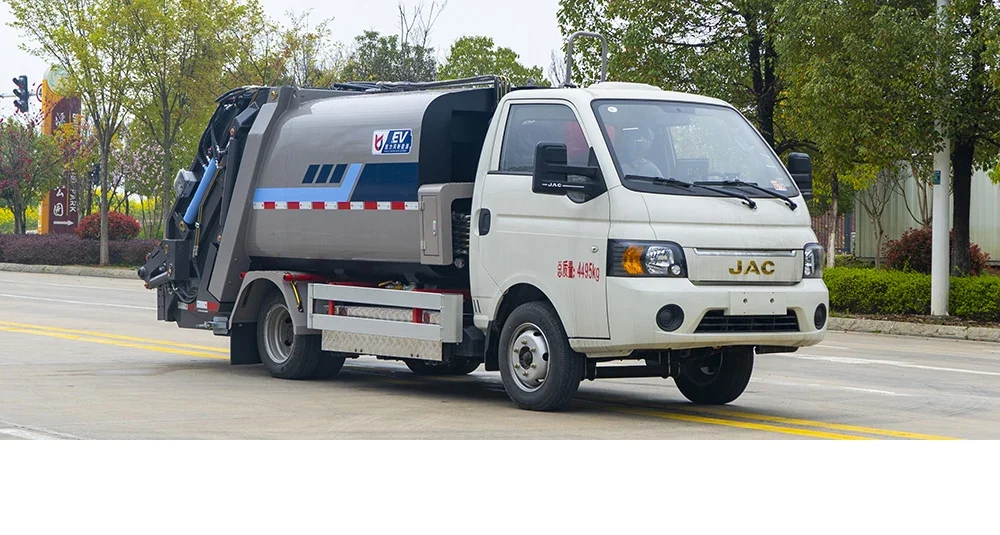
Technical specifications
Published reference data for the vehicle discussed in this guide. Confirm the selected build in the supplier’s specification.
| Parameter | Published value |
|---|---|
| Chassis | JAC Kaida i3 |
| Body volume | 5.3 m³ |
| Gross vehicle mass | 4,495 kg |
| Wheelbase | 2,850 mm |
| Battery chemistry | CATL lithium iron phosphate |
| Battery capacity | 55.7 kWh |
| Hopper volume | 330 L |
| Leachate tank | 180 L |
| Listed cycle time | 18–22 s |
About the Kaili JAC Electric Garbage Compactor
Built on the JAC Kaida i3 electric chassis, this compact rear-loading compactor combines a 5.3 m³ body with a CATL lithium iron phosphate battery. It is a candidate for depot-based collection routes where charging can be planned around daily operations.
Applications and operating scenarios
An electric compactor is worth assessing for collection routes that return to a depot with planned charging access. The stop pattern and time spent operating collection equipment are important parts of the duty cycle. Route suitability should be reviewed using the actual operation, not distance alone.
How to read the specifications
Battery capacity is an energy figure, not a guaranteed driving range. Auxiliary work, terrain and charging equipment affect the operating assessment. Body volume and vehicle gross mass also remain separate from the usable payload of the completed vehicle.
Selection and quotation checklist
Prepare route distances, gradients, stop counts, shift times and available charging details. Ask for a route-specific energy assessment and the selected charger specification. Review battery and high-voltage support arrangements with the supplier rather than assuming a general diesel service plan applies.
Reference scope
This guide uses the published Kaili vehicle reference linked below. The technical values describe that reference, not every vehicle in the range. Final equipment, availability and destination requirements are confirmed for the quoted build.


