Match the truck to how waste reaches it
Choose a garbage compactor when crews repeatedly collect compatible bins along a route and need enclosed accumulation between stops. Choose a hook loader when waste is already gathered in removable containers and the vehicle mainly exchanges and transports them. A skip loader provides another container handling arrangement, with its own geometry and site requirements. These are collection systems with different infrastructure needs. Comparing body volume alone misses the time spent loading, positioning containers, travelling to disposal and returning to the route. Start with the collection method that the municipality can actually support, then review the particular chassis and equipment.
Measure the entire cycle
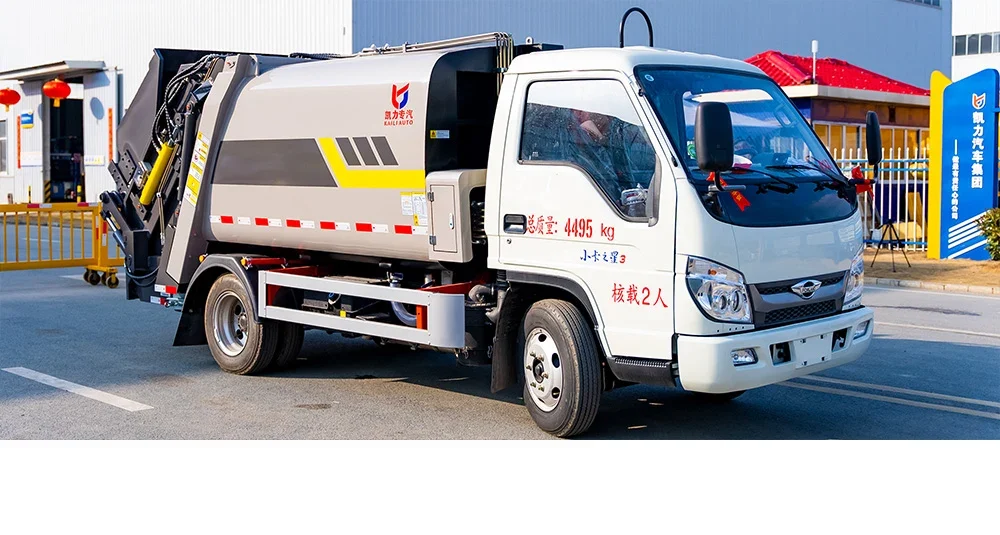
For a bin route, record stops, bin types, access restrictions and where loading takes place. The Kaili Foton reference lists compatible 120, 240 and 660 L bins, but the exact quoted lifting arrangement still needs confirmation. For container work, map every exchange location, the available approach space and the receiving facility. A truck advertised for a nominal container volume may still be unsuitable for the existing hook height or rail spacing. Include the time during which a container remains on site. A single truck serving several containers can be useful only when spare containers, safe exchange locations and disposal access are available. Compare operational plans using measured route data rather than a predicted compaction ratio.
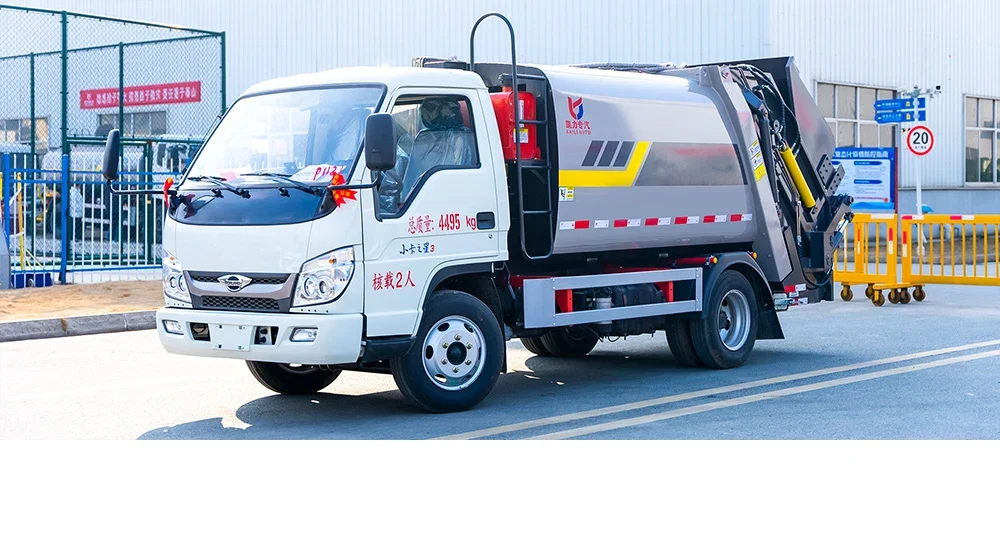
Kaili Foton 5.8 m³ Garbage Compactor: manufacturer reference photograph. The photograph illustrates a catalogue reference, not the exact vehicle quoted for your project.
A clearly assumed neighbourhood example
Assume a municipality has household bins on narrow residential streets and a separate market using stationary containers. This is an illustrative planning case, not a customer result. The residential service points toward a compactor because the waste is presented at frequent individual stops. The market may favour a container truck if containers can be exchanged without obstructing the public and the receiving site accepts their discharge method. Buying one vehicle to perform both roles could introduce daily equipment changes or incompatible interfaces. Review whether two smaller specialised services, or a contracted transfer service for one stream, would fit the staffing and maintenance resources better. The final choice depends on actual dimensions and route quantities.
Body and interface details change the decision
A compactor purchase needs agreement on bin-lifter geometry, hopper access, leachate containment and the waste types allowed by the manufacturer. A hook-loader purchase needs a drawing of container length, hook position, supporting rails, locks and transport restraint. Existing containers should be checked individually because repaired or mixed fleets can differ. A skip-loader container should never be treated as interchangeable with a hook container simply because both are called garbage boxes. Also compare maintenance access and the ability to obtain wear components locally. Ask how the body is supported for authorised servicing. A larger body creates little benefit if access, axle loading or lifting compatibility prevents its practical use.
Turn the quotation into an acceptance plan
Send photographs and dimensions of representative bins or containers, route sketches, waste descriptions, disposal conditions and the destination. Request the exact chassis, body drawing, included lifting equipment, empty mass and proposed loaded axle distribution. Ask the supplier to identify excluded waste streams and the documents required for staff training. At acceptance, reconcile identification plates and the equipment list with the quotation. A controlled demonstration should use the agreed compatible receptacle and manufacturer procedure, with a trained operator and an exclusion area. Record fit, locks, leakage observations and control behaviour. Treat unjamming or servicing as separate tasks under the applicable energy-control arrangements; a sales demonstration is not permission for staff to enter a hazardous mechanism.
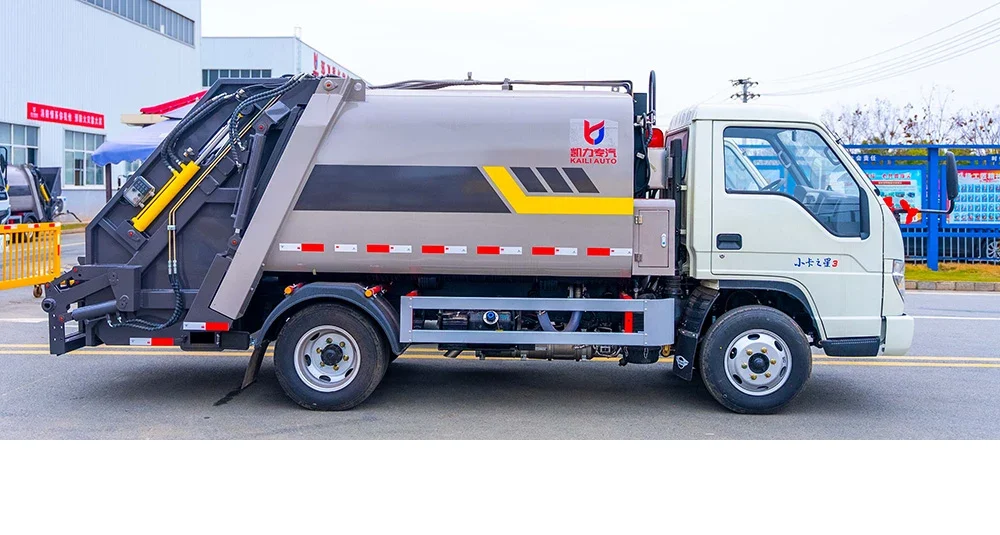
Kaili Foton 5.8 m³ Garbage Compactor: manufacturer reference photograph. The photograph illustrates a catalogue reference, not the exact vehicle quoted for your project.
Make the comparison commercially complete
Compare the number of receptacles included in each bid and the cost of providing additional compatible containers. For a hook or skip system, a low truck quotation may omit the boxes needed to keep collection points open while loads are travelling. For a compactor, a replacement bin programme may be needed to standardise the route. State ownership, cleaning and repair responsibility for those receptacles. Keeping infrastructure costs visible allows the buyer to compare service systems on the same basis without claiming that either truck has an inherently lower operating cost.
Questions buyers often overlook
Can a hook loader collect loose household waste directly? It usually serves containers; any direct-loading attachment or method must be expressly specified, so do not assume it replaces a bin-route compactor. Does a bigger compactor always reduce disposal trips? The result depends on allowable payload, waste density, route quantities and receiving-site access; body volume cannot establish a guaranteed trip count. Can old containers be reused? Potentially, but interface drawings, condition and manufacturer approval are needed before the quotation assumes compatibility. A container replacement budget may change the commercial comparison more than the truck price. SUI AUTO can coordinate review of the proposed configuration, while the manufacturer and buyer must settle the written equipment scope and acceptance evidence.
References and related reading
Review the listed references in their stated scope and check the current requirements for your actual build and destination.
- OSHA 1910.147: Control of hazardous energy (United States reference)
- NIOSH: Preventing struck-by injuries and deaths when working with refuse trucks
- Kaili Foton 5.8 m³ Garbage Compactor: published vehicle reference
- CLW Dongfeng 5 m³ Hook Loader: published vehicle reference
- CLW Dongfeng 5 m³ Skip Loader: published vehicle reference
- Kaili Foton Compactor: Body Volume and Bin Compatibility
- Prepare your vehicle requirements


