
Make cleanliness a handover deliverable
Require a component-based cleanliness target, a traceable oil-condition report and the installed filtration details. A new truck and clear-looking oil do not establish that the hydraulic circuit meets its component requirements. Agree the target with the equipment builder before production and identify how acceptance samples will represent the completed circuit.
This is a purchasing evidence question. It differs from choosing a pump or ordering a generic service kit. The buyer needs a defensible starting condition for the actual crane, lift or other hydraulic body, plus enough identification to maintain that condition after delivery.
Start with the most sensitive component
HYDAC advises buyers to obtain cleanliness requirements from machine and component manufacturers. Different components may have different requirements. Ask the integrator to reconcile them and state the target used for the assembled system. A number copied from an unrelated vehicle manual provides weak support for your purchase.
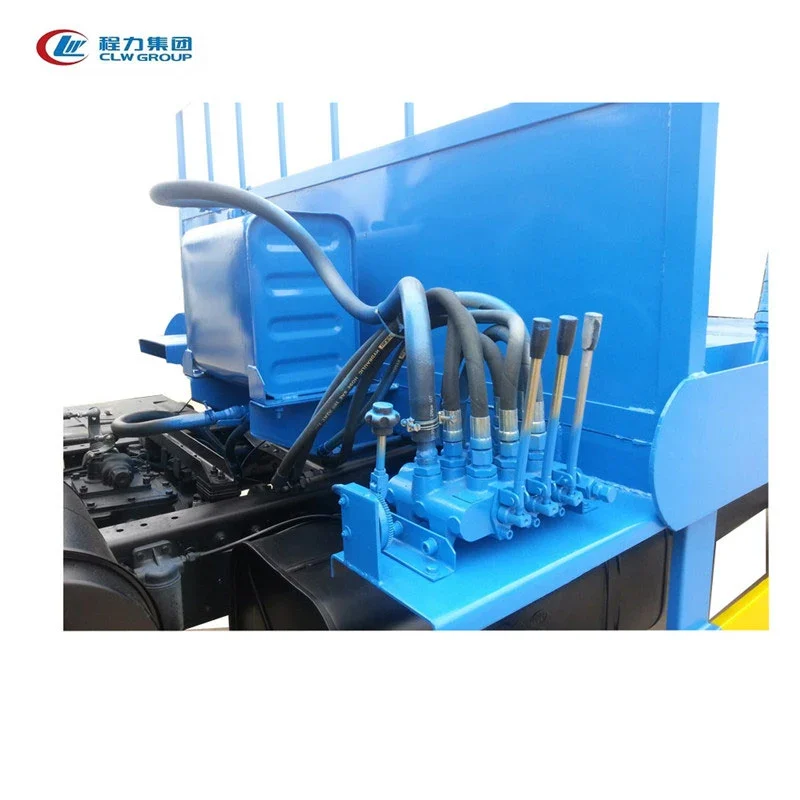
Manufacturer reference photograph. Exposed hydraulic hoses and valve connections on a skip loader illustrate the assembled circuit included in the cleanliness handover scope.
Create a short component register covering the pump, control valves, motors and other sensitive equipment. Record their exact variants and the source documents for fluid requirements. The builder should explain which requirement governs the system. This prevents a late component substitution from silently changing the cleanliness basis or the filtration needed to maintain it.
A micron label is only part of the filter specification
The quotation should identify the complete filter assembly and element, location in the circuit, relevant efficiency data and service indicator. A statement such as fine filter does not identify what was installed. Even a nominal micron number leaves several procurement questions unanswered.
Ask the supplier which operating flow and fluid conditions were used to select each assembly. Confirm access for element replacement and whether the exact element is commercially available in your region. Request the approved replacement reference, rather than assuming that another cartridge with similar dimensions has the same filtration performance.
Define what the sample report represents
Agree who will obtain the sample, when the completed system is assessed and how the sample location is identified. The report should connect the vehicle, date, fluid, laboratory or instrument, and test method. Include the machine condition described by the supplier at sampling. These records let both parties understand what the result establishes.
A sample of unopened supply oil describes that sample. It does not automatically characterize the assembled circuit after hoses, valves and reservoir have been installed. Ask for a completed-system result and a written explanation of any limitation. The procurement team should review records; qualified personnel should conduct the actual sampling under the manufacturer's procedure.
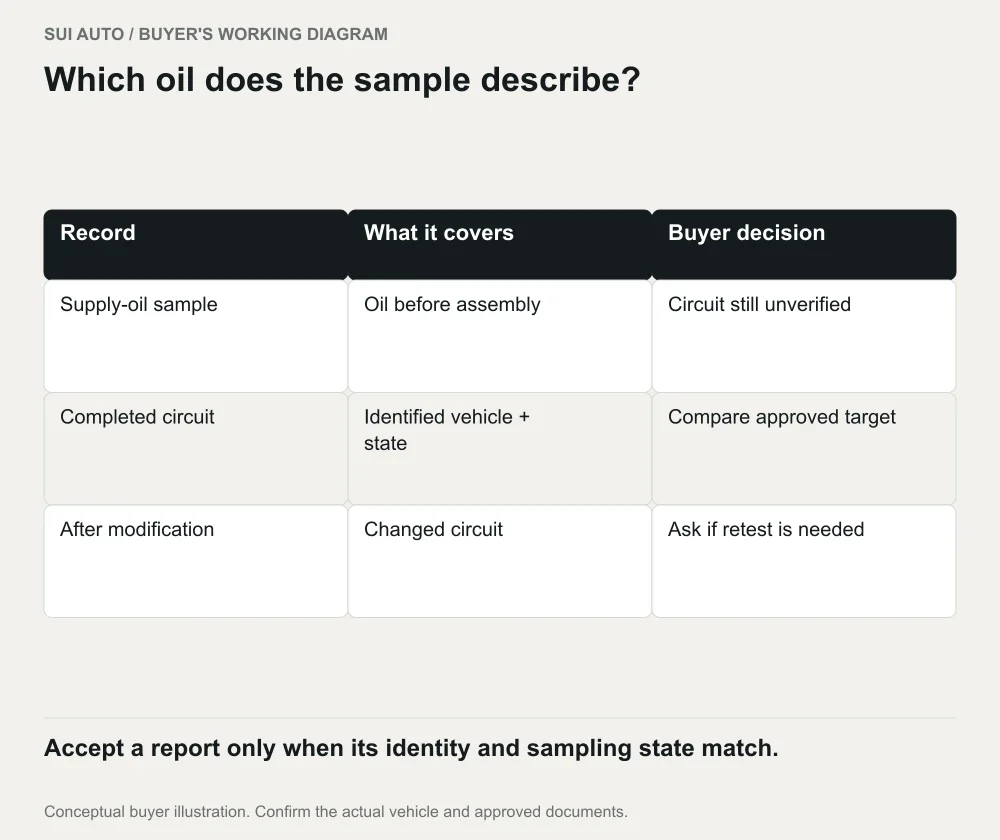
Conceptual illustration. Evidence table separates new supply oil from oil in the completed hydraulic circuit. Accept a report only when its identity and sampling state match.
Use three comparison columns
Separate initial acceptance, in-service monitoring and corrective work. Initial acceptance establishes the handover condition. Monitoring describes how the owner can follow the system after commissioning. Corrective work defines responsibilities when an agreed result is missed. Combining all three into one sentence about maintenance creates room for misunderstanding.
For each offer, compare the cleanliness target, evidence supplied, filter identities and support arrangement. One supplier may include a documented final assessment; another may offer it as an additional inspection. Both approaches can be priced fairly once the scope is explicit. Ask who retains the original report and how the vehicle is identified within it.
A hypothetical mixed-fleet purchase
Assume a buyer orders two loader-crane trucks with different control systems. The first draft specification gives both the same generic oil target because the chassis are similar. Component review then shows that the body builders used different valves and fluid documents. The buyer asks each integrator to confirm its own system requirement.
The useful comparison becomes evidence quality and maintainability, rather than forcing identical targets. The owner also checks whether local laboratories and replacement elements support both systems. This example illustrates a review method. It does not assign an ISO code to any linked model or promise that their fitted components are identical.
Write the delivery checklist around traceability
Request the approved fluid specification, filled fluid identity, component register, filter assembly and element references, final assessment report and the manufacturer's maintenance guidance. Record any transport preservation measures that affect the system after testing. Ask the supplier to explain how the accepted condition is protected before commissioning.
If the vehicle is modified after acceptance, identify which changes require review. Replacing a hose, opening a reservoir or changing a valve can affect the relevance of an earlier report. Let the responsible technical party decide whether additional evidence is necessary. A signed handover should list outstanding exceptions rather than treating every unchecked item as satisfactory.
Questions worth resolving before payment
Which component determines the cleanliness target? Is the report for this completed body or a generic production sample? What identifies the installed fluid and filter elements? Is the sampling method documented? Who reviews a failed result and approves any repeated assessment? Can local service providers obtain the exact approved elements?
Parker's filtration handbook supports obtaining written component requirements. Apply that principle to the actual build. It does not mean every truck should adopt the example cleanliness levels in a general handbook. The contracted equipment manufacturer's approved requirement should remain the basis for acceptance.
FAQ: Does transparent oil mean it is clean enough?
Visual appearance cannot establish a particle-count target. Request the agreed measurement report and its identification details rather than relying on a photograph of the reservoir.
FAQ: Should every truck use the strictest code available?
The integrator should establish a suitable requirement from the installed components and duty. A purchasing team should not invent a universal target without that assessment.
FAQ: Can another filter element be substituted locally?
Only after the responsible manufacturer approves equivalence for the application. Matching dimensions or a similar micron label alone is insufficient evidence of equivalent performance.
References and further reading
Planning a purchase? Follow the overseas buyer guide for specification, payment, shipping and import preparation.