Budget for a usable vehicle at your operating site
The vehicle quotation is only one part of the cost of importing a special-purpose truck. A useful landed-cost worksheet follows the truck from its agreed delivery point to arrival, clearance and readiness for your operation. Separate quoted amounts, estimates and unresolved charges. Do not add a freight estimate to a price that already includes the same freight. Start with the contract's exact trade term and named location, then ask the forwarder and broker to identify what remains for you to pay. Tax and duty figures must come from a current destination assessment for the actual vehicle, not from another buyer's shipment.
Divide the worksheet into cost groups
Use groups for vehicle and options, origin transport and handling, international carriage, insurance, destination handling, customs-related payments, inland delivery and commissioning. Put spare parts and operator handover in their own rows if they are not included in the purchase. Record currency, quotation validity, responsible payer and supporting document for every row. If a service is optional, show both the base case and the chosen option. A single estimated total hides uncertainty; a structured worksheet makes it easier to see which missing answer could materially change your purchase decision.
Keep taxable value separate from your management budget
The amount your organization budgets and the value used by customs are not interchangeable calculations. Ask the broker to identify the relevant tariff classification, valuation treatment and applicable taxes for the destination. Provide the real transaction documents and itemized charges. Do not assume that the factory price is the sole tax base or that every cost is taxed in the same way. The broker's explanation should show the inputs, the date checked and the unresolved conditions. This article offers a procurement worksheet, not a universal duty formula or a country-specific tax determination.
An illustrative subtotal
Consider a hypothetical purchase with a vehicle and options subtotal of 60,000, origin charges of 1,200, carriage of 4,500, insurance of 400 and destination handling plus inland delivery of 2,000, all expressed in one illustrative currency. The pre-tax subtotal is 68,100. These are invented worksheet inputs, not current prices. Taxes, approval costs, commissioning and contingency are still open. The correct conclusion is that the vehicle price alone understates the planned spend; it is not that this subtotal represents a usable import quote. Replace every example amount with transaction-specific evidence before committing funds.
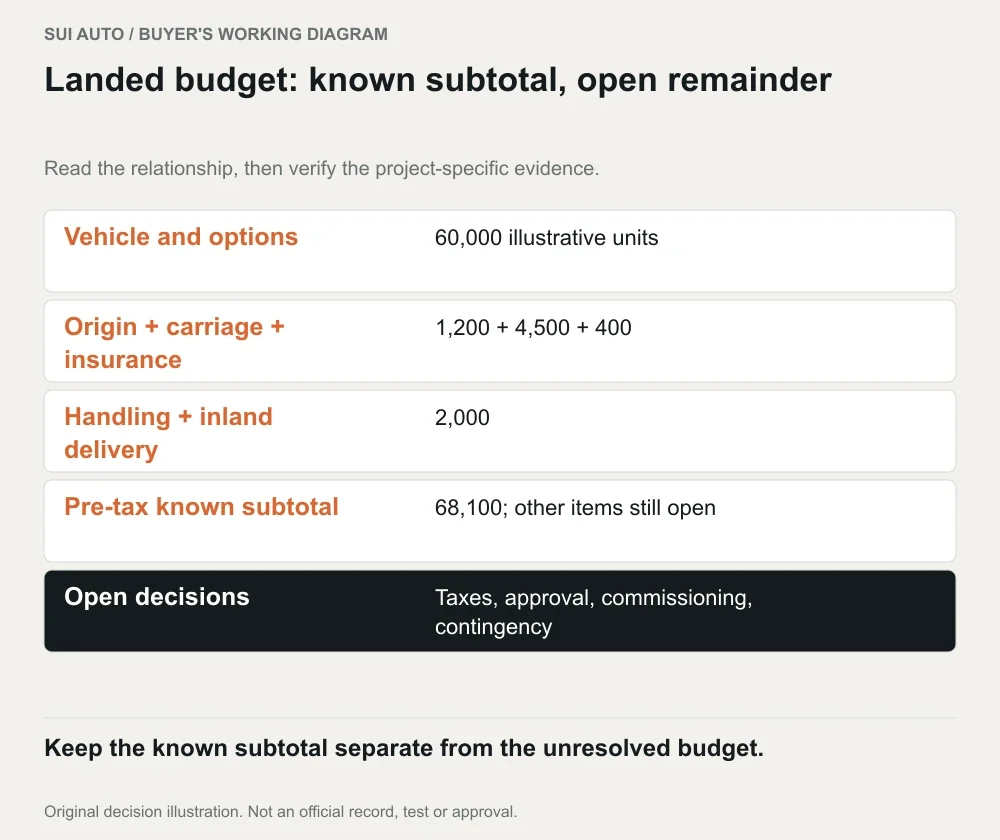
Buyer illustration: hypothetical subtotal from the article, with open cost categories kept outside the result.
Use scenarios for the uncertain costs
Where the delivery plan is not finalized, compare clearly labeled scenarios. One might use a direct sailing and another a transshipment; one might include a remote inspection and another a site handover. Describe why the assumption changes rather than adding an unexplained percentage to every line. Currency exposure, storage caused by document delays and unplanned local modifications deserve separate attention. A contingency is a management allowance, not a supplier fee or a promise that all risk is covered. Review the worksheet when the final dimensions, carrier acceptance and destination document plan are available.
Measure cost against the work the truck will do
Once the landed budget is understood, compare the proposed truck's likely operating fit. A cheaper import that cannot enter the site, connect to existing equipment or receive local maintenance may fail the project even if it clears customs. Identify expected utilization, workshop access and recurring consumables separately from the one-time landed cost. Do not claim an operating saving without a workload and maintenance basis. SUI AUTO can help compare configuration scope and sourcing alternatives, while the buyer, broker and service providers supply the destination-specific charges and local operating inputs.
Does a CIF quotation include all arrival costs?
Do not assume it does. Read the precise quotation and delivery responsibilities, then request a destination-charge breakdown from the forwarder or broker. The ICC checklist explains that CIF is a maritime trade term with an insurance obligation; it is not a substitute for checking customs, handling and onward delivery costs in your transaction.
Can I use a competitor's import tax percentage?
Only as a question to investigate, not as a confirmed budget input. Differences in vehicle function, classification, origin, declared value, exemptions and destination rules can change the assessment. Ask your broker for a current written calculation based on your actual proposal before making a final purchasing decision.
References and related reading
Planning a purchase? Follow the overseas buyer guide for specification, payment, shipping and import preparation.