Put the attachment in the lifting requirement
Describe the complete suspended arrangement, including the intended attachment and lifting accessories, when requesting a loader crane. A pallet's product mass alone does not establish the crane duty. The crane supplier must confirm how its load chart accounts for hooks, winches, extensions and other equipment in the selected configuration.
This is a narrower question than choosing a crane by maximum capacity or working radius. The buyer is trying to identify the useful load that remains with the actual handling equipment fitted. A familiar crane class does not answer that question without the correct chart and attachment convention.
List what will actually hang from the crane
Identify the product, packaging and any pallet forks, grab, rotator, spreader or other equipment. Provide the relevant supplier documents and masses where available. Mark unknown values for confirmation rather than rounding them away. Include the configuration used at the most demanding delivery position.
Ask the crane supplier which items are already included in its published ratings and which require separate allowance. This avoids both overlooking attachment mass and subtracting it twice. The final answer should be tied to the actual chart and installed configuration. A purchasing spreadsheet cannot replace that manufacturer clarification.
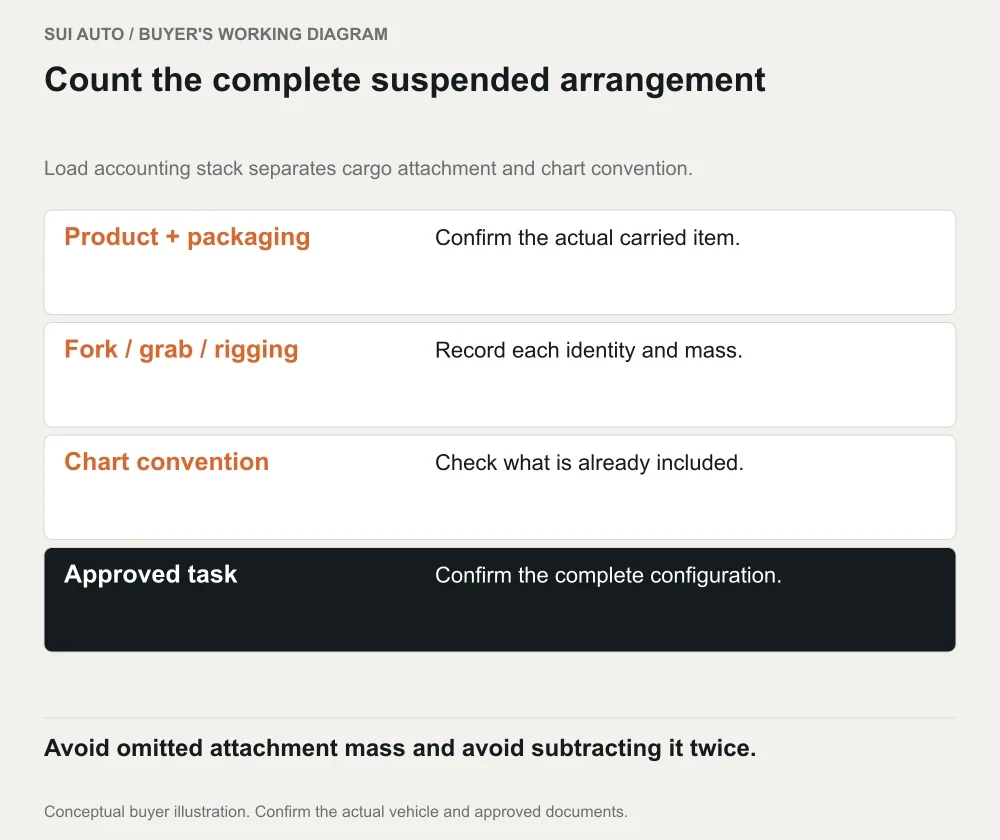
Conceptual illustration. Load accounting stack separates cargo attachment and chart convention. Avoid omitted attachment mass and avoid subtracting it twice.
Define the task at the attachment interface
The working position of the load may differ from the position implied by a simple hook sketch. Ask the attachment supplier to provide its dimensional drawing and required interface. The crane integrator should assess the complete arrangement, including the load location relevant to its approved chart.
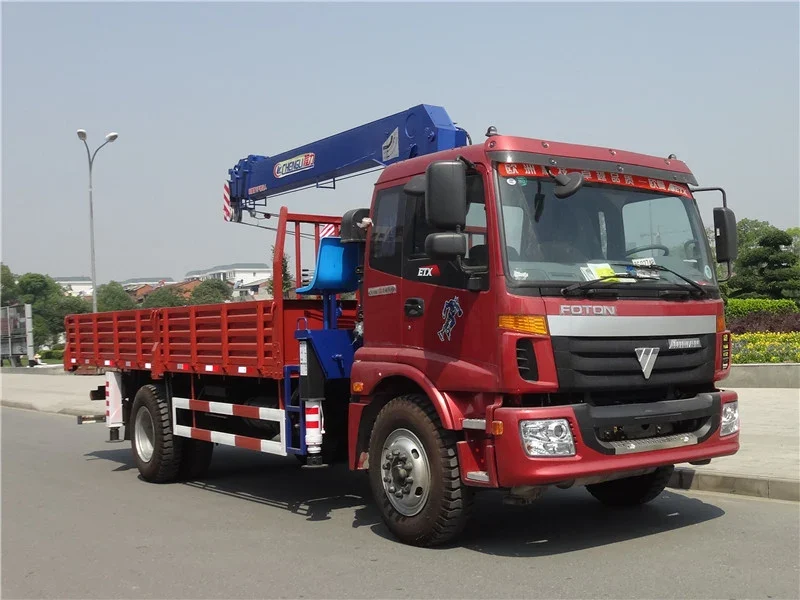
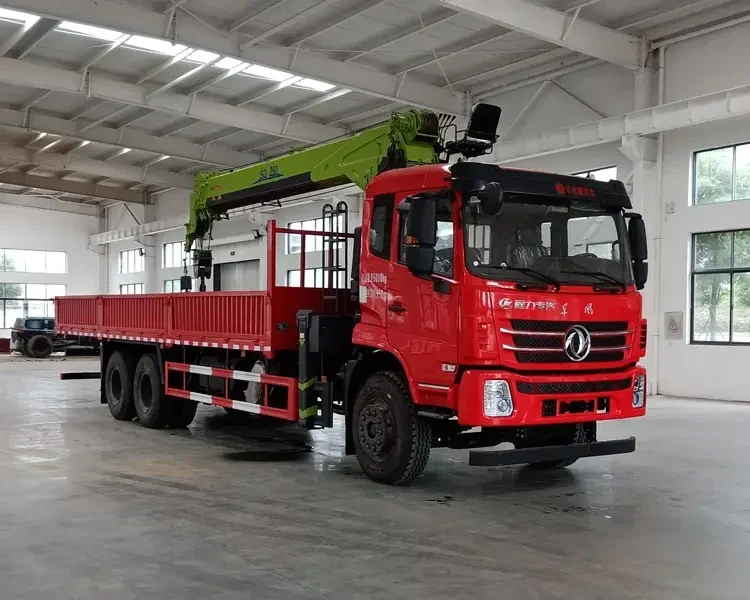
Manufacturer reference photograph. The folded crane and cargo bed show where a lifting task interfaces with the load; the selected attachment remains a separate specification.
For a hydraulic attachment, provide the exact model and application. Ask the suppliers to confirm its hydraulic and control interface as part of the integrated installation. Do not infer compatibility because the crane and attachment both have hoses or a visually similar connection. Pressure, flow and controls require the responsible manufacturer's approval.
Read the chart for the selected equipment
Request the chart and limitations for the exact crane, extension and attachment arrangement. Identify any configuration-dependent conditions. The supplier should explain how the required task is checked without reducing the decision to a single maximum tonnage figure.
PALFINGER's attachment-aware weighing discussion illustrates why accessories belong in the load picture. It does not mean all crane weighing systems include every attachment automatically or that linked CLW models have that feature. Ask the actual supplier what the installed system measures, what is configured and what remains the operator's responsibility.
Compare two handling approaches
One offer may use a hook and conventional lifting accessories, while another uses an attachment designed for the cargo. Compare the complete approved handling arrangement, required useful load, cargo interface and storage provisions. The cheaper attachment price may conceal a larger crane or a different vehicle installation requirement.
Include the mass carried on the truck during road transport and its storage location. A handling attachment occupies payload and space even when it is not suspended. Ask the body builder to include it in the final mass and load-distribution assessment. Keep lifting capacity and road carrying capacity as separate checks within the same purchase brief.
A hypothetical pallet-delivery comparison
Assume a distributor knows the heaviest pallet mass but has not selected forks. Two crane quotations appear to meet the product-only requirement at the delivery radius. The buyer then supplies the fork drawing and mass, asks how accessories are treated in each chart and requests a renewed assessment.
One configuration may still fit the task; another may need a different crane or attachment. This is a hypothetical outcome, not a numerical lift plan. The buyer should obtain the manufacturer's written conclusion rather than calculating an approved net capacity from a simplified formula. Site setup and ground conditions still need their separate assessment.
Specify the acceptance evidence
The supply schedule should name the crane and each attachment, associated load documents, interfaces and approved configuration. Ask the responsible supplier to propose a safe functional demonstration with suitable personnel and a documented plan. Match the delivered attachment identities and markings to the approved equipment list.
Require the operating instructions and any configuration-specific chart to accompany the vehicle. If an attachment is substituted, review the revised mass and interface before accepting it. A demonstration with an empty fork or unloaded grab can show basic movement, but it does not establish the entire contracted lifting duty.
RFQ checklist for useful-load clarity
Send the cargo mass and dimensions, packaging, attachment model and drawing, handling position and required outreach. Ask which accessory masses are included in each chart, which configuration applies and who approves the combination. Request transport storage details and the resulting vehicle mass assessment.
Confirm how attachments will be identified in the fleet and how service replacements are approved. Similar-looking forks or grabs may have different masses and ratings. A traceable register helps dispatchers and operators select the intended equipment, while the manufacturer's instructions remain the authority for operation and capacity limits.
FAQ: Should all attachment mass simply be subtracted from the chart?
Ask the crane manufacturer to explain its chart convention. Some equipment may already be included; the approved assessment must avoid both omission and double counting.
FAQ: Does a weighing display replace a load chart?
No. Ask what the system measures and which configuration it supports. The crane's approved chart, setup conditions and operating instructions still apply.
FAQ: Can another attachment with the same nominal capacity be used?
Capacity alone does not establish equivalence. Mass, geometry, interface and the integrated crane approval need review before substitution.
References and further reading
Planning a purchase? Follow the overseas buyer guide for specification, payment, shipping and import preparation.