Start with source conditions and an approved target
A mobile water purification truck should be selected against characterised source water, a defined intended use and a qualified verification plan. No buyer should assume that a vehicle can make every source suitable for drinking. The XDR SITRAK reference describes monitoring, filtration, purification and storage equipment, which identifies a system category rather than a guaranteed treatment result. This article concerns procurement and professional review, not treatment instructions. The responsible water authority and qualified laboratory must establish the applicable water-quality criteria, sampling requirements and release decision for the proposed service.
State a bounded planning example
Assume an emergency organisation expects to support an established relief site using a source already identified by the local water authority. Provide the available analysis, expected variation and the intended users to the system designer. If no reliable analysis exists, include source assessment as a required preliminary task rather than choosing equipment from a flow-rate claim. A supplier may need to exclude certain conditions or propose additional treatment stages. Those exclusions are useful procurement information. They prevent a broad phrase such as emergency purification from being mistaken for unrestricted suitability in unknown contamination scenarios.
Ask for the complete treatment boundary
Request a process description showing what enters the system, which treatment stages are proposed, what is monitored and where treated water is stored or transferred. Ask what source conditions the proposal assumes and which contaminants or conditions it does not address. Have the authority's specialist review that explanation. A list of filters or a photograph of equipment does not prove the resulting quality. The supplier should distinguish rated throughput under stated conditions from usable output in the buyer's actual scenario. Any performance claim must identify its test basis and the exact installed equipment.
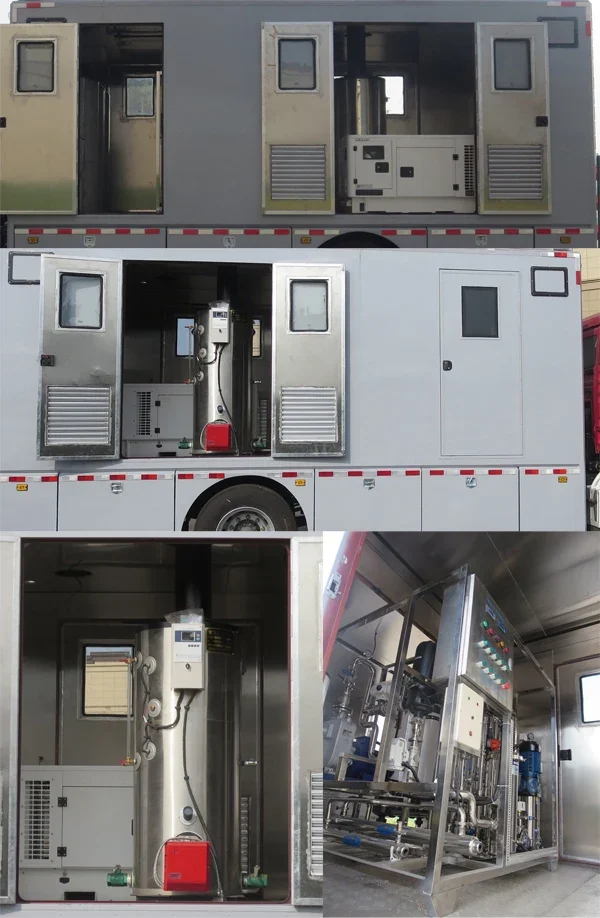
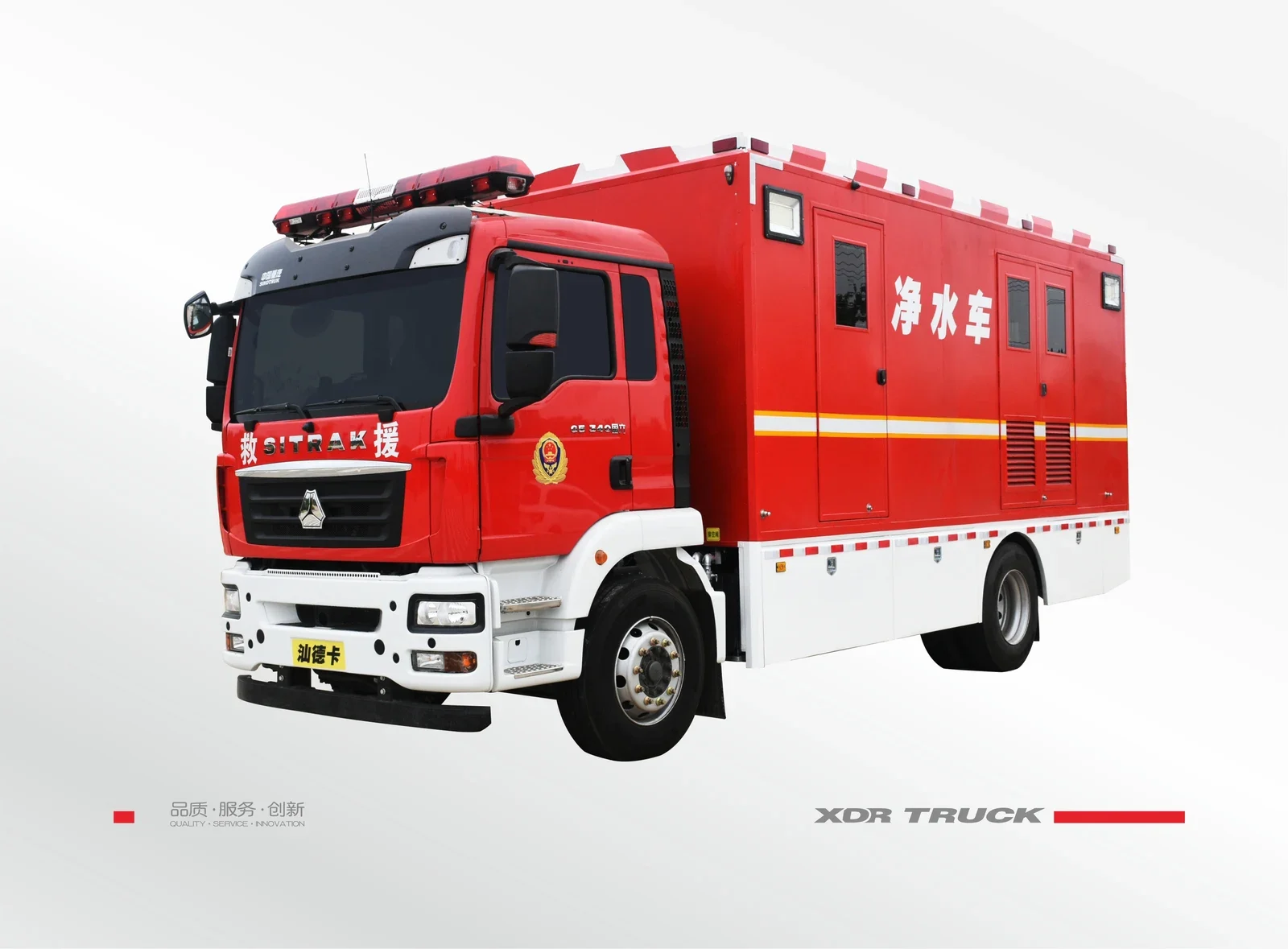
Manufacturer reference photograph. The manufacturer's equipment views show treatment hardware inside the vehicle; the process flow and water-quality evidence remain separate.
Create a source-condition field, a supported-treatment field and a verification field beside any throughput figure. If the source evidence is missing, keep suitability conditional. A higher catalogue output should not close an unknown source or release criterion in the comparison sheet.
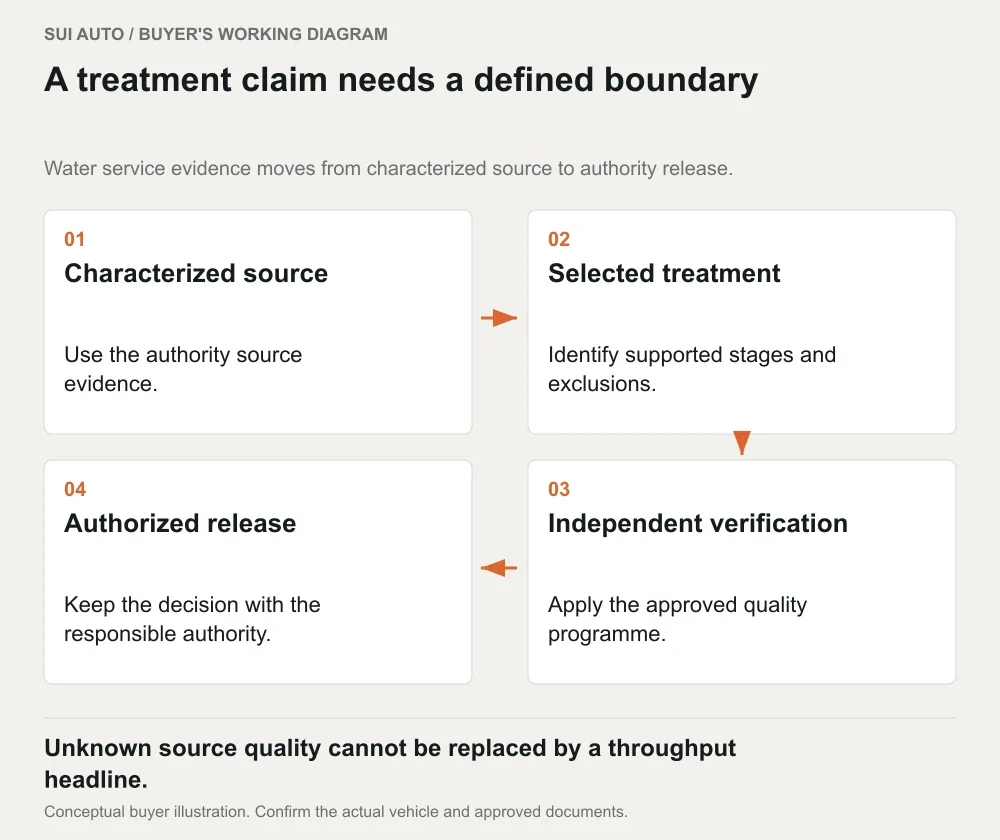
Conceptual illustration. Water service evidence moves from characterized source to authority release. Unknown source quality cannot be replaced by a throughput headline.
Plan verification independently of the sales claim
Agree which laboratory or competent body will verify water quality and what documentation the buyer must receive. Tests should reflect the defined source and target, with acceptance criteria approved before construction or demonstration. Do not accept appearance, taste or a single promotional demonstration as evidence of potable quality. The authority should also determine how quality is checked during service and what conditions require the unit to stop releasing water. Keep these responsibilities visible in the procurement package. Equipment supply and ongoing water-quality management are related tasks, but one does not automatically include the other.
Consumables can govern practical availability
Ask for the exact consumable types, shelf-life information, storage requirements and replacement schedule prescribed by the manufacturer. Establish which parts are available locally and what special servicing is needed. Include waste or reject-water management in the site planning review. A capable treatment system may be impractical at a remote site if its consumables cannot be replenished or its waste arrangements are unresolved. Ask the supplier to list required external utilities and staffing competence. Do not invent a universal maintenance interval or assume all filtration elements can be interchanged because they have similar physical dimensions.
Build the enquiry and handover record
Send the source-water evidence, intended output use, target authority requirements, site utility information, expected duty and support constraints. Request a process schedule, performance evidence, consumable list, manuals, training scope and vehicle integration documentation. At acceptance, verify equipment identities, supplied test records, laboratory results under the agreed programme and the limits stated in the instructions. Record outstanding source uncertainties and site responsibilities. SUI AUTO can coordinate the manufacturer and evidence package, while the qualified water specialists determine suitability and authorise use. The reference truck's photographs cannot establish the quality of water produced at a future site.
Avoid the single-number procurement shortcut
A headline throughput can distract the buyer from feed-water limits, consumables and quality verification. Create a comparison sheet that gives those boundaries equal prominence. A proposal with a lower stated output may be the only one supported by evidence for the specified source; the purchaser needs the specialist's assessment to make that distinction. Conversely, a suitable treatment process can still be impractical if the site cannot support its utilities or waste handling. Record why the selected arrangement is workable as a complete service, rather than presenting the highest catalogue capacity as the reason for purchase.
Questions about treatment claims
Can a published capacity be treated as guaranteed potable output? No; feed-water conditions and the approved verification basis matter. Can the system be selected before a source is known? A preliminary discussion is possible, but suitability remains conditional. Does onboard monitoring replace laboratory verification? Only the responsible authority can determine the required verification programme; do not assume that it does. An enquiry is stronger when it records these unknowns openly. This keeps the procurement decision connected to a defined water service instead of an unsupported promise that one vehicle solves every emergency water problem.
References and related reading
- USFA: Using standards when selecting and purchasing responder equipment
- WHO: Drinking-water quality guidelines, fourth edition with first and second addenda
- XDR SITRAK Mobile Water Purification Truck: published vehicle reference
- SITRAK Mobile Water Purification Truck: Specifications and Selection Guide
- Prepare your vehicle requirements
Planning a purchase? Follow the overseas buyer guide for specification, payment, shipping and import preparation.