Ask for whole-body evidence as well as panel thickness
Evaluate the complete insulated body, including joints, frames, floor connections and openings. A panel-thickness statement describes one construction feature; it does not establish the heat transmission of the finished vehicle. Request the supplier's thermal-performance basis and a drawing that identifies how interruptions in insulation are treated.
The purchasing question is whether the quoted body matches the thermal evidence offered for it. This is distinct from selecting a refrigeration unit or choosing a door arrangement. Both choices depend on the body, but neither automatically verifies the effect of its joints, penetrations and structural connections.
Identify the places where insulation changes
Ask the body builder to mark door surrounds, panel joints, floor edges, attachment points and service penetrations. Include additional openings for evaporators, lighting or other equipment. A simple cross-section can explain the construction more clearly than a finished interior photograph.
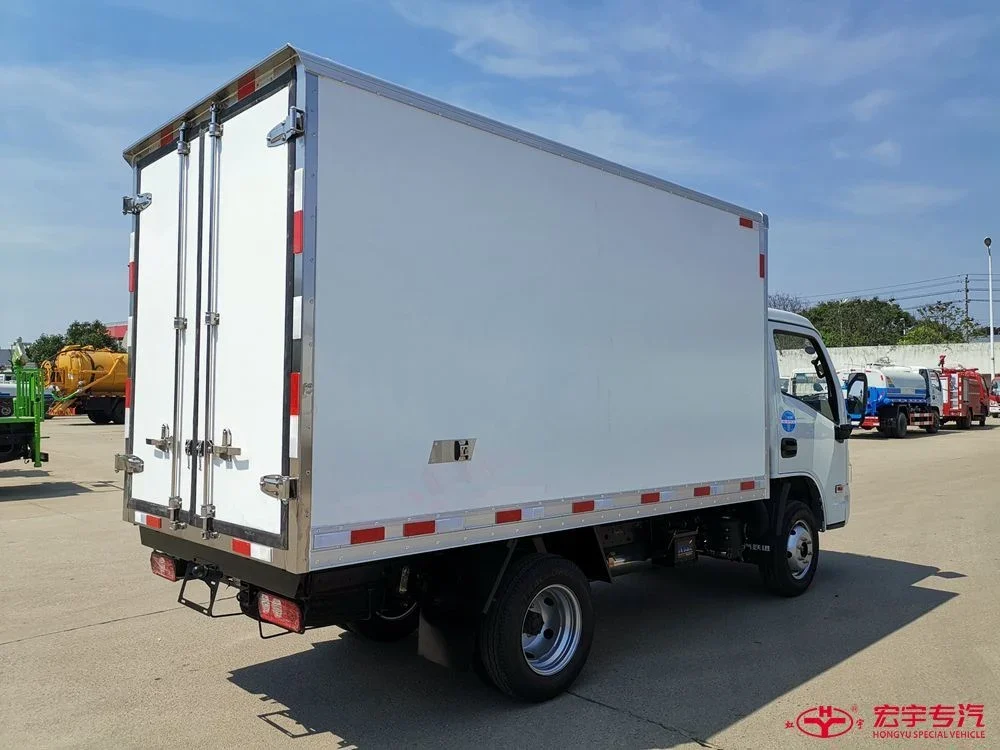
Manufacturer reference photograph. Rear door surrounds and panel junctions are visible on this refrigerated body; their internal insulation needs drawings and evidence.
The buyer need not invent a thermal design. The drawing helps identify which details require the builder's explanation and which differ from the tested reference. If the supplier offers only a panel sample, ask how its claimed performance relates to the complete installed box. Keep the limitations visible in the quotation comparison.
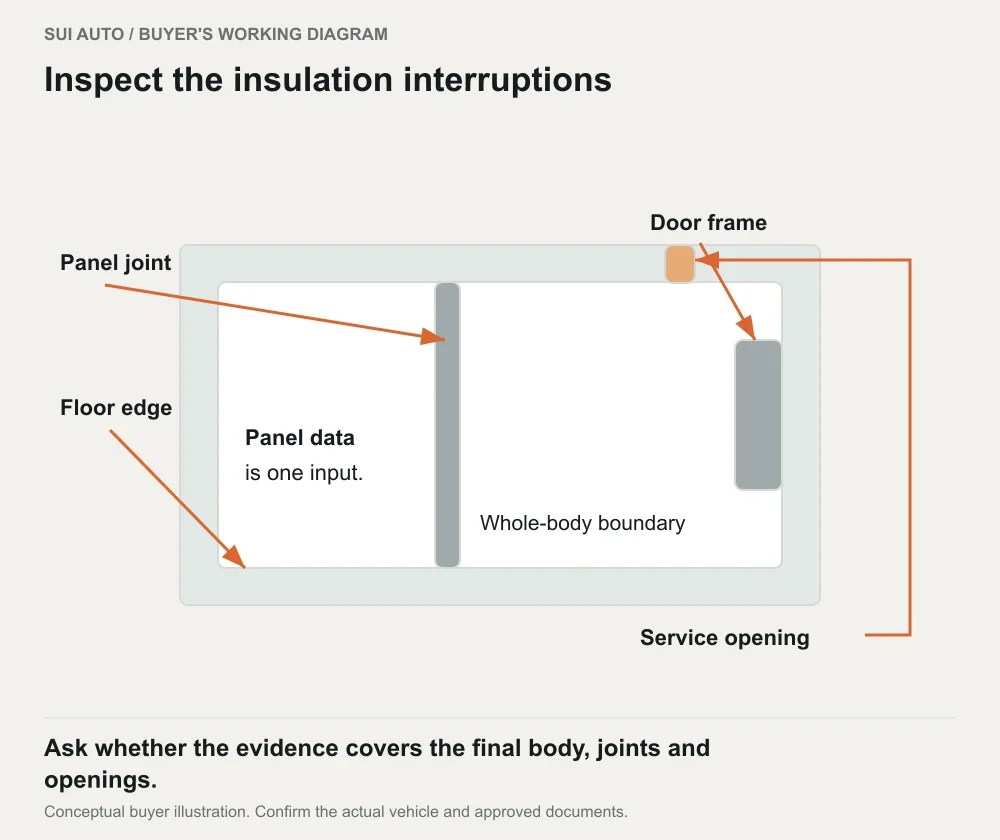
Conceptual illustration. Insulated box section identifies panel joint floor edge door frame and service opening. Ask whether the evidence covers the final body, joints and openings.
Distinguish a material value from a body result
A foam property, a panel test and a whole-body heat-transmission result concern different boundaries. Ask exactly what was tested, which method was used and what object the report identifies. Check whether the report covers a representative body or the actual supplied vehicle.
UNECE's ATP materials illustrate formal methods for assessing insulated equipment. They are useful for understanding why complete-body performance is a separate question. Their existence does not establish that a linked truck has ATP certification, or that ATP applies to every purchase. Confirm the destination and cargo requirements through the competent parties before specifying a formal approval route.
Review modifications against the evidence
An extra side door, a different floor or another refrigeration opening can change the body being supplied. Ask the builder whether its existing evidence still applies and who approves that conclusion. Record the configuration and drawing revision to which each test document refers.
Compare quotations on the same final body arrangement. One supplier's standard body report may not cover the customized layout in its offer. Another may provide a specific review or additional testing. Pricing these scopes explicitly prevents a buyer from assuming that a familiar construction label covers every later change.
Use thermal images with clear limits
Thermal imagery can help document patterns under defined conditions, but an attractive image alone does not provide a complete heat-transmission assessment. Ask the inspecting specialist to define what the images are intended to establish, the relevant environmental conditions and the interpretation limits.
Avoid inventing a universal acceptable color or surface-temperature difference. Different test conditions and surfaces can produce different appearances. If imagery forms part of acceptance, agree the procedure and reporting format with the responsible specialist. Pair it with drawings, construction identification and the thermal evidence required by the contract.
A hypothetical side-door revision
Assume a distributor approves a compact refrigerated box and later adds a side door for city deliveries. The original supplier file contains a report for a closed-side reference body. The purchasing team asks for confirmation that the revised construction remains within the supplier's supported thermal design.
The review may lead to a revised door frame, different unit selection or additional evidence. These are possible outcomes, not an automatic need for a larger unit. The key is that the changed body receives an explicit technical response before fabrication. The scenario does not claim a specific certification or performance result for the linked vehicles.
Build an acceptance plan around the actual question
Separate construction inspection from functional refrigeration testing. Construction inspection checks the contracted materials, joints, seals and openings. Functional testing addresses the assembled temperature-control package under agreed conditions. Neither should silently substitute for the other.
Require photographs of important construction details before they become inaccessible where the supplier agrees such evidence is practical. Record the finished body's identity, drawings and documents. If a thermal assessment is included, identify its scope and any exclusions. A completion signature should show which checks were performed and which remain for commissioning.
Questions for a comparable RFQ
What whole-body performance evidence supports this exact layout? Does the document cover the quoted dimensions and openings? Which construction details differ from the reference? How are floor edges and door frames treated? Who reviews later modifications? What formal approval, if any, is included in the price?
Also ask how repair work should be documented after delivery. A damaged panel or altered opening may affect the relevance of earlier evidence. The owner needs a defined approval and repair route rather than an assumption that any replacement panel restores the original performance. Keep the original construction file with the vehicle's service records.
FAQ: Does thicker insulation always produce a better complete body?
Thickness alone cannot answer the whole-body question. Compare the specified construction and its supported performance, including joints, frames and openings.
FAQ: Does a thermal camera prove ATP compliance?
A thermal image is not an ATP certificate. Any formal approval must follow the applicable process and identify the equipment it covers.
FAQ: Can a new door be added after delivery?
Request the responsible body and refrigeration suppliers' review before modification. The change may affect construction, thermal performance, cargo access and the relevance of existing evidence.
References and further reading
Planning a purchase? Follow the overseas buyer guide for specification, payment, shipping and import preparation.