Compare the conditions before the capacity numbers
Compare refrigeration capacity only when ambient temperature, return-air temperature, drive condition and measurement basis match. A larger published output at a mild test condition can be less relevant than a smaller output documented at your required duty. Ask the refrigeration supplier to select the unit for the complete insulated body and delivery brief.
This is a narrower question than choosing a refrigerated-truck size. It resolves why two plausible unit quotations may appear inconsistent even before price enters the discussion. The useful comparison is a supported operating point for the intended load, rather than the largest number on either brochure.
Put every rating in one comparison sheet
Create columns for unit model, refrigeration output, ambient condition, return-air condition, drive source and operating speed. Add the document revision and any stated test basis. Keep the original units alongside a checked conversion if the offers use different measurement systems. Leave missing conditions visible instead of guessing them.
Thermo King's C-Series specification information identifies ambient and return-air conditions alongside its ratings. Its E-200e page also presents capacity against stated box and ambient conditions. These examples demonstrate why the conditions belong in a comparison. They do not establish that either brand or model is installed on the trucks linked to this article.
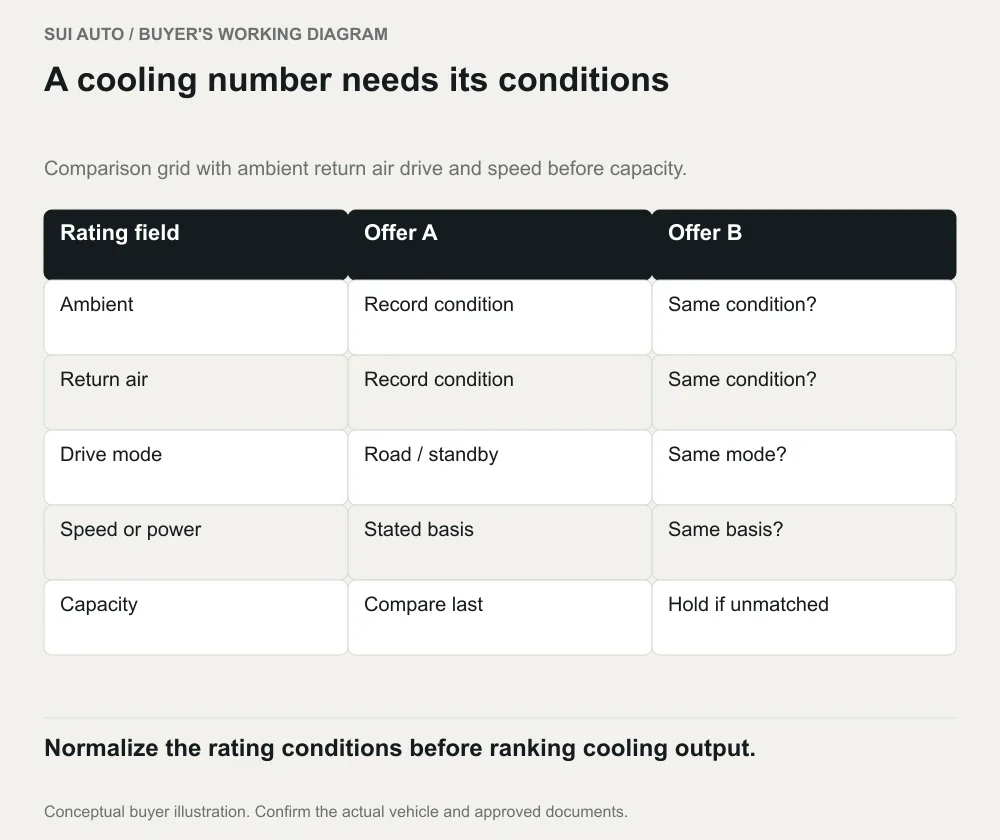
Conceptual illustration. Comparison grid with ambient return air drive and speed before capacity. Normalize the rating conditions before ranking cooling output.
Distinguish maintained cargo from product cooling
Tell the supplier the cargo temperature at loading and the required delivery condition. Maintaining correctly prepared product and removing a large amount of product heat are different duties. A temperature setpoint alone does not describe the work. Product type, packaging and loading process belong in the brief.
Require the supplier to state its assumptions about preconditioned cargo. If the operation sometimes loads warmer goods, request a separate assessment of that exception. Avoid treating an empty-body pull-down result as proof that the vehicle will cool every possible product load within a specified time. The cargo owner's quality requirements should determine what evidence is necessary.
Check available drive conditions
For a direct-drive unit, ask which vehicle or compressor operating condition supports the quoted capacity. A brochure point may not represent repeated delivery stops or an engine operating at a different speed. For an electrically supplied system, document the available power and the unit's specified operating mode.
Do not combine ratings from road operation, standby operation and another power option into one best-case number. Ask for a separate assessment for every mode you intend to use. This exposes whether overnight parking, loading queues or extended stops need additional infrastructure or a different refrigeration arrangement before the truck is ordered.
Compare unit and body as an integrated package
The unit selection needs the insulated body's geometry and thermal performance, plus the expected air path and door schedule. A correctly described refrigeration unit may still be paired with an inadequately documented body. Ask who owns the integration calculation and who signs off the finished vehicle's intended duty.
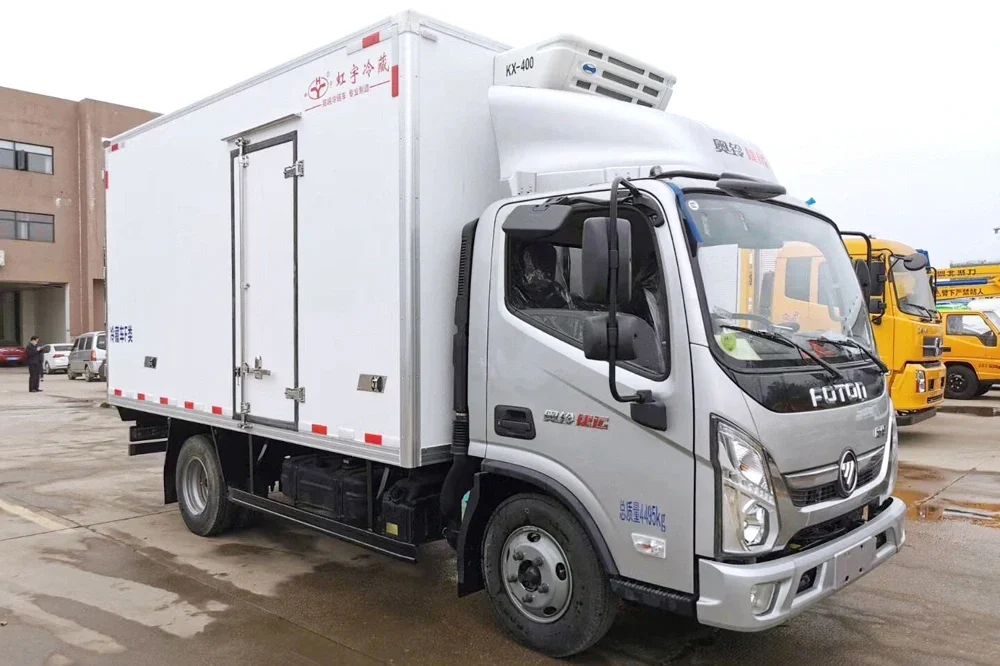
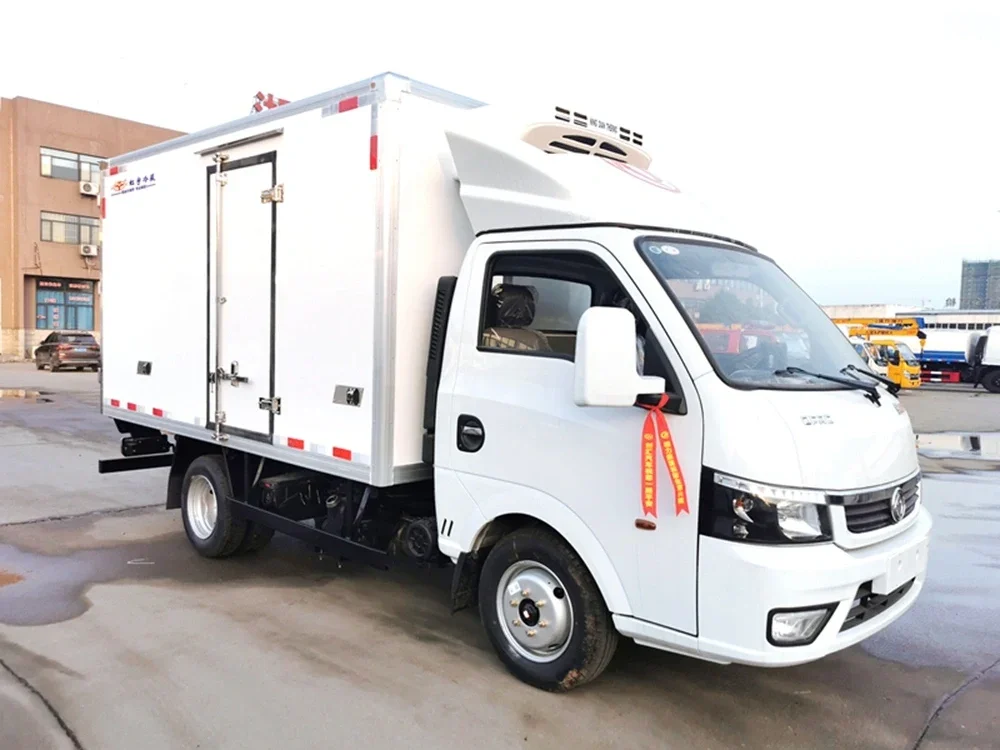
Manufacturer reference photograph. The cab-top refrigeration unit and box body are visible together; compare the quoted unit and body as one package.
Review the clear usable dimensions after the evaporator, ducts, bulkheads and required air spaces are included. If a larger unit changes the cargo arrangement, reassess the load plan. Buyers should avoid comparing maximum body volume from one offer with capacity data for a different body on another. The selected combination should have one traceable specification.
A hypothetical frozen-food route
Assume two suppliers quote units for the same delivery body. One lists output at a higher return-air temperature; the other supplies a rating closer to the required cargo condition. The buyer asks both suppliers for selection evidence under the same ambient and operating assumptions, including the planned delivery stops.
The revised comparison may narrow the apparent capacity difference or reveal that one offer needs another unit variant. The buyer then compares installed cost and support for the selected variants. This is a decision example, not a capacity calculation. The ambient conditions, cargo requirement and duty must come from the actual project.
Make factory evidence answer the right question
Agree what will be demonstrated: basic operation, empty-body pull-down, temperature stability under specified conditions or another specialist-approved assessment. Identify sensors, calibration evidence, initial conditions, door state and available power. Record the entire relevant period rather than a single display reading.
The acceptance file should explain its limitations. A factory without representative ambient conditions may provide unit-selection documentation plus an agreed commissioning assessment. That can be useful when clearly stated. A video showing frost on an evaporator cannot substitute for the contracted evidence about the actual insulated vehicle and intended duty.
RFQ checklist for comparable answers
Send body drawings, insulation details, loading temperature, target cargo condition, product and packaging information, door-opening pattern, route environment and planned power modes. Ask for the exact selected unit, selection calculation or application approval, rating documents and the proposed acceptance plan.
Confirm who supplies the refrigerant information, maintenance documentation and locally obtainable service parts. If another unit is substituted, require a renewed comparison against the same duty sheet. Written conditions let the buyer assess equivalence without assuming that similar names, evaporator dimensions or nominal capacities mean identical performance.
FAQ: Is the lowest advertised temperature the best selection rule?
It is insufficient on its own. A temperature claim needs its conditions and must be assessed with body heat load, operating mode and cargo requirements.
FAQ: Can capacities in watts and BTU per hour be compared?
Units can be converted, but matching the thermal and drive conditions comes first. A correct conversion does not make different test conditions equivalent.
FAQ: Does a successful empty-body test guarantee the route?
It verifies the conditions actually tested. Route performance needs the agreed application assessment, loading assumptions and any additional acceptance evidence specified for that operation.
References and further reading
Planning a purchase? Follow the overseas buyer guide for specification, payment, shipping and import preparation.