
A sailing estimate is only one stage of delivery
The advertised sea-transit time does not tell you when an imported truck will be available for work. Your schedule also needs production readiness, inspection, transport preparation, booking, origin handling, destination clearance, inland movement and handover. Ask the supplier and forwarder which event starts each quoted period. Separate an estimated vessel arrival from a contractual delivery commitment and from your own commissioning target. No single number applies to every route or vehicle. Build the project calendar from identified stages and current providers' information instead of treating a general ocean-transit estimate as a guaranteed operational date.
Work backward from the required operating date
Start with the day the truck must be ready for your project, then identify the tasks that must finish before it. Local approval, operator training, depot preparation and receiving inspection may need time even after customs release. Ask the broker what document review can happen before departure. Ask the supplier which production and inspection stages can be reliably dated and which depend on approval decisions. Record a responsible person for each stage. A schedule with no owner for clearance or site handover can look complete while leaving the most important transition unplanned.
Clarify booking and cutoff assumptions
The forwarder should explain the proposed route, service type, cargo acceptance and booking conditions. A completed truck may still miss the intended departure if dimensions change, documentation is late or origin handling is not ready. Ask which cutoffs apply and what the alternative plan is if the booking changes. If the vehicle uses special-cargo handling, confirm that the accepted transport arrangement remains available. Keep production readiness and carrier acceptance as separate items. A supplier's statement that a truck is ready does not establish that the nominated sailing has space or that all booking requirements are satisfied.
Build a schedule with ranges, not invented certainty
For uncertain stages, record a provider-supported estimate and the assumptions behind it. You may create a management base case and a delayed case, but clearly label them as planning scenarios. Include the effects of transshipment, document correction and public holidays only where the actual parties identify them as relevant. Do not add an unexplained universal allowance to every shipment. Update the plan when an accepted booking, inspection outcome or broker review supplies better information. Keep the previous version so the team can see what changed and why the operating target was revised.
An illustrative construction-project calendar
Imagine a contractor needs a concrete mixer for a project start. It records the required operating date, local receiving and handover tasks, the broker's document review, the forwarder's current route proposal and the supplier's production plan. The contractor discovers that its original date assumed immediate customs release and no operator handover. It revises the plan before ordering instead of relying on the sea-transit figure alone. This is an illustrative planning case with no claimed transit days or delivery guarantee. The important lesson is that operational readiness is a chain of tasks, each supported by its own evidence.
Use milestones to communicate progress
Track specification accepted, production ready for inspection, inspection exceptions resolved, carrier acceptance confirmed, departed, arrived, released and handed over. Ask for evidence appropriate to each status. A booking confirmation is not proof of departure, and a vessel-arrival notice is not proof of customs release. Share the milestone register with the supplier, forwarder, broker and receiving team. When a date changes, state the effect on the next task and identify who will update the customer-facing plan. This keeps the discussion focused on the actual constraint instead of repeating an outdated promised arrival day.

Kaili trucks lined up in a yard show a factory-side event. That event is different from port receipt, vessel loading and destination release, so an ocean-delivery plan should record those milestones separately.
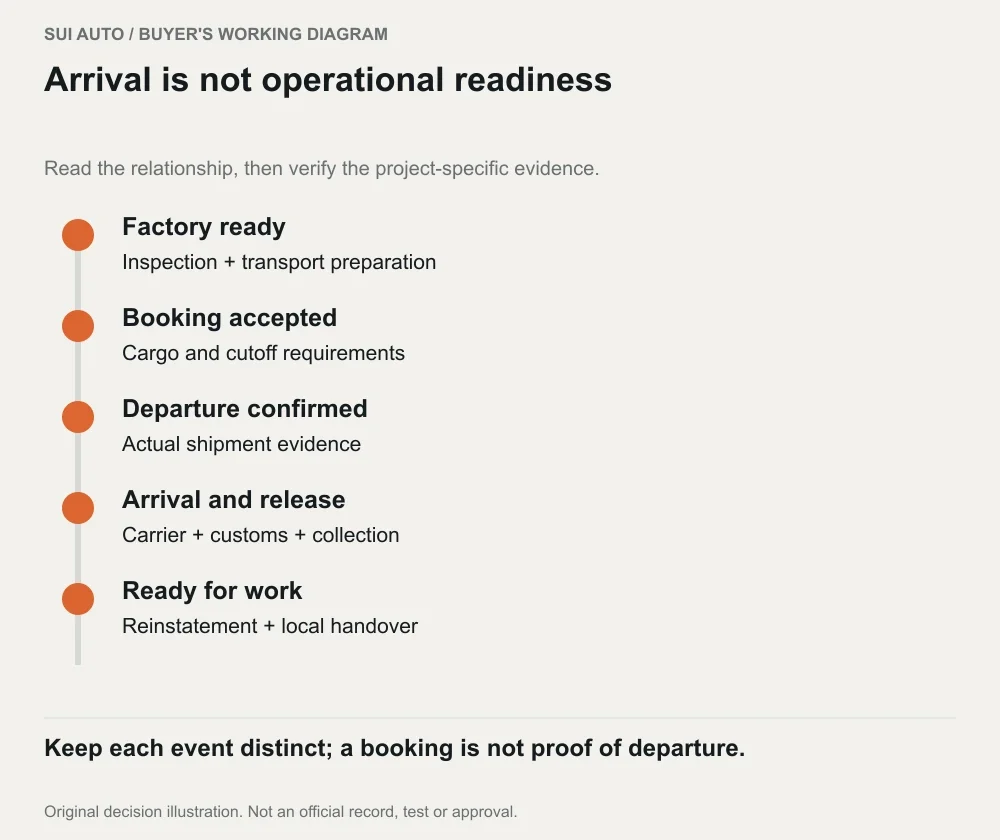
Buyer illustration: delivery-planning milestones without promised transit or clearance durations.
Can SUI AUTO guarantee a fixed sea-transit time?
A website cannot establish a current sailing commitment for an unbooked vehicle. Ask for the route, carrier proposal, booking status and any contractual delivery terms for your transaction. Treat schedule estimates as estimates unless the relevant agreement expressly states otherwise.
When should I prepare the destination documents?
Ask the broker to review requirements before production and update the file as identifiers and shipping information become available. Waiting until the vessel arrives leaves less time to correct discrepancies. The International Trade Administration's document guidance notes that missing or inconsistent records can delay a shipment; destination rules must still be checked locally.
References and related reading
Planning a purchase? Follow the overseas buyer guide for specification, payment, shipping and import preparation.