Review the intermediate loads, not only a full tank
Ask the tanker integrator to assess the intended compartment loading and delivery sequence, including intermediate conditions after unloading. A vehicle can have an acceptable total mass while the remaining liquid is distributed differently across its axles. Tank size alone cannot establish which compartment combinations suit a multi-drop route.
This review concerns the position and state of the load. It is separate from choosing compartments to segregate products or specifying cleaning access. The compartment drawing, liquid densities, installed equipment and actual route sequence form the starting point. Qualified vehicle and tank specialists must approve the applicable cases.
Prepare a delivery-state schedule
List the planned starting contents of each compartment and the deliveries expected at each stop. Include the actual liquid and its specification, plus the largest and smallest likely consignments. Mark situations where a compartment remains partially filled or where the route order changes.
Ask the builder to identify which states need a calculation or other approval evidence. The buyer supplies the operational facts; the integrator decides the technical assessment. Do not turn a simple sales sketch into an unreviewed loading instruction. The final operating limits should be issued by the responsible technical party for the supplied vehicle.
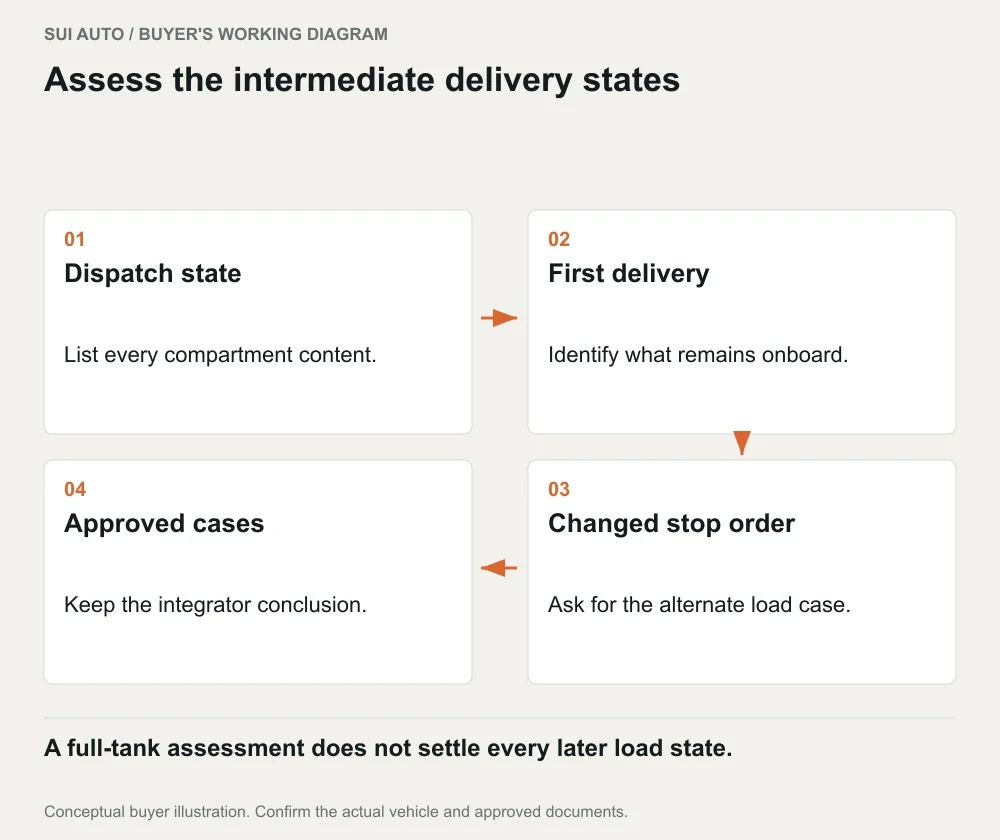
Conceptual illustration. Four state record distinguishes dispatch first drop changed order and approved load cases. A full-tank assessment does not settle every later load state.
Separate three different limits
Tank geometry, permissible filling and vehicle carrying mass describe different constraints. A nominal volume may exceed the usable filling volume for a particular service. The permitted liquid mass also depends on the approved vehicle and route requirements. Compare each item under its proper name.
Manufacturer tables sometimes use total and effective volume labels inconsistently. When they disagree, request the actual tank drawing and approved capacity documentation rather than selecting the larger value. Ask how the chosen liquid density was used in the mass assessment. This reduces the chance that a capacity headline becomes an unsupported payload promise.
Request calculation cases that match the job
The assessment should identify the actual chassis and body, installed component masses and compartment locations. Ask which loaded, partially discharged and empty conditions were considered. Have the integrator connect the results to the specific vehicle drawing rather than a generic example from another wheelbase.
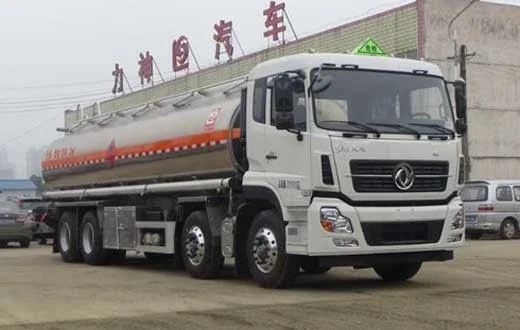
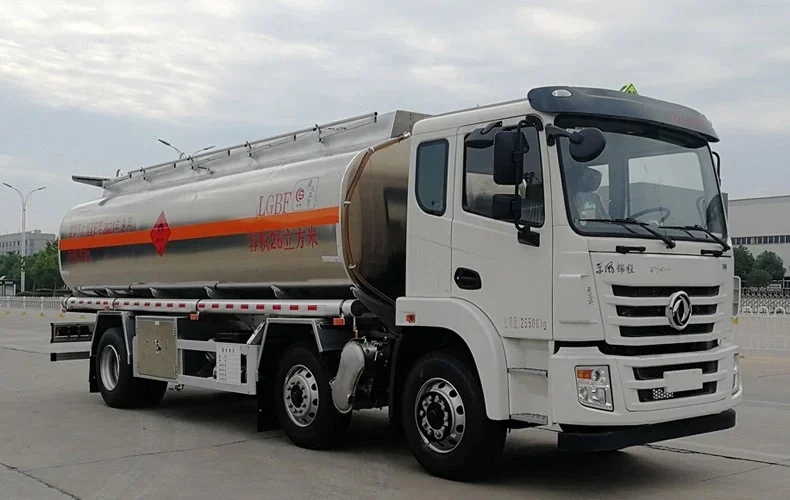
Manufacturer reference photograph. This long fuel-tanker body spans four axles, making compartment locations and staged axle-load calculations relevant to the enquiry.
Include equipment that changes the finished vehicle mass, such as transfer systems, hose storage and selected accessories. A later addition can make an earlier calculation less representative. At purchase review, compare the final equipment schedule against the assumptions used in the load assessment. Ask for a documented response to any mismatch.
Keep liquid movement in the specialist review
Partial filling also raises questions about liquid movement within the tank. UNECE's CTU guidance discusses surge in its own transport-unit context. It is a reason to obtain the correct specialist assessment, not a basis for applying a generic fill-percentage rule to every road tanker.
Ask the tank and vehicle specialists which rules and approved design features apply to the proposed vehicle and liquid. Do not infer that partitions or baffles eliminate all stability concerns. The buyer should request the supported configuration and operating limitations. Training and route procedures remain part of the operator's responsibility after handover.
A hypothetical two-stop fuel route
Assume a buyer normally unloads the rear compartment first, but an alternative customer schedule requires another compartment to be discharged first. The original quotation only describes a fully loaded tanker. The buyer asks for both planned route states to be included in the integrator's assessment.
The approved result may support both cases, restrict one sequence or require another compartment arrangement. Any of those can be a valid outcome if documented. The example does not prescribe a safe discharge sequence or a legal axle limit. Those decisions depend on the actual vehicle, liquid and destination requirements.
Compare suppliers by the completeness of their file
Offer A may list a large tank volume and a chassis mass. Offer B may supply a drawing and identify the operating cases included in its assessment. Ask A for the missing technical scope before concluding that its larger volume is better value. A documented limit can be more useful than an unexplained capacity advantage.
Require each supplier to identify the finished vehicle's mass evidence and how it relates to the calculation. Check that selected pumps, compartments and other options appear consistently. If the delivered build differs, record the deviation and obtain a review before accepting it as equivalent. Avoid signing a general conformity statement while unresolved mass assumptions remain.
RFQ and acceptance checklist
Send the liquid specification, compartment quantities, delivery sequence, chassis preference, equipment options and destination route requirements. Request a compartment drawing, capacity definitions, mass distribution assessment and the resulting approved operating cases. State who is responsible for destination review and who issues the loading information.
At acceptance, match compartment identification and installed equipment to the drawing. Retain the actual vehicle mass record and relevant tank documents. Make any remaining destination review visible as an outstanding item. Neither a factory plate nor a website table alone answers every loading and route question for the purchaser.
FAQ: Is total vehicle mass enough to check loading?
It does not describe how the load is distributed. Ask the integrator to assess the relevant axle and compartment states for the actual build.
FAQ: Does more compartment capacity guarantee more deliveries?
The useful capacity depends on filling limits, liquid density, mass distribution and the route. Compare approved operating cases rather than nominal volume alone.
FAQ: Can the buyer choose any discharge order?
Use the sequence and load cases approved for the supplied vehicle and service. Request review when the planned operation changes rather than assuming every combination is equivalent.
References and further reading
Planning a purchase? Follow the overseas buyer guide for specification, payment, shipping and import preparation.