Review clearance with the body and load installed
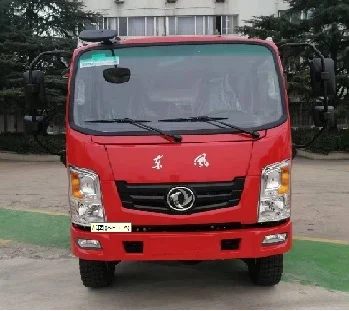
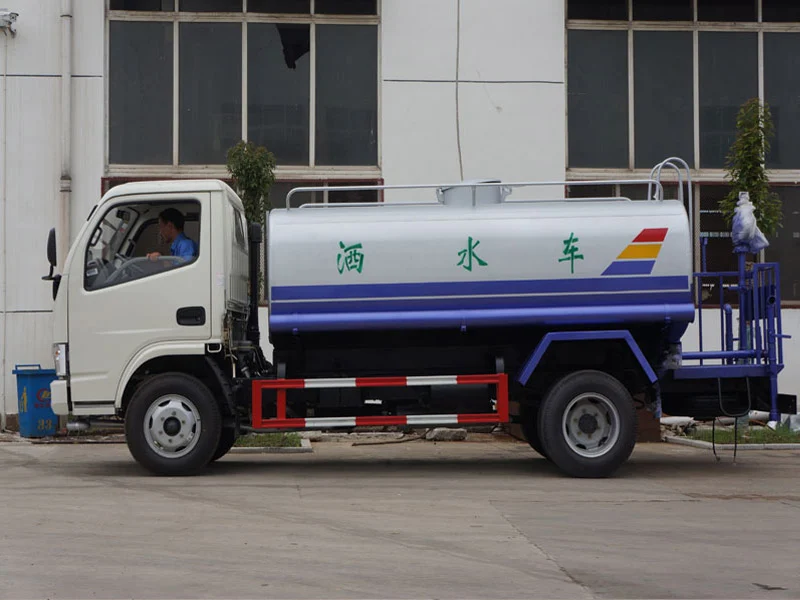
Choose site-access geometry using the finished truck's lowest points, overhangs and loaded condition. A chassis ground-clearance figure cannot describe every pump, tank, step, guard or rear fitting added by the body builder. Ask for a completed-vehicle side view and the location of vulnerable equipment.
Approach and departure angles describe different end-clearance relationships. Breakover clearance concerns the vehicle passing over a crest between its axles. These checks complement overall height, width and swept path. A vehicle can fit through a gate and still contact a ramp or raised threshold inside the site.
Identify the points that actually govern access
Front: review bumper, steps, guards and any equipment ahead of the front axle.
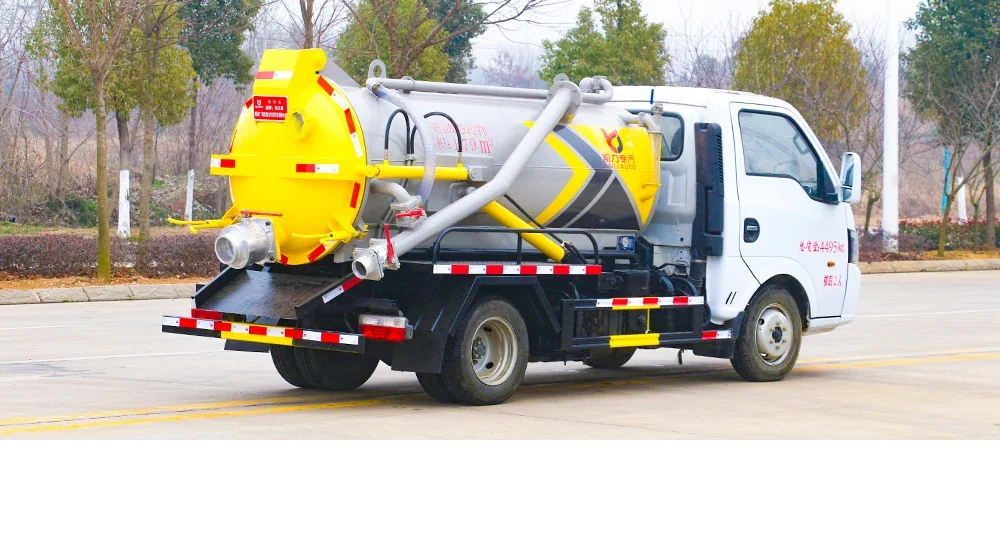
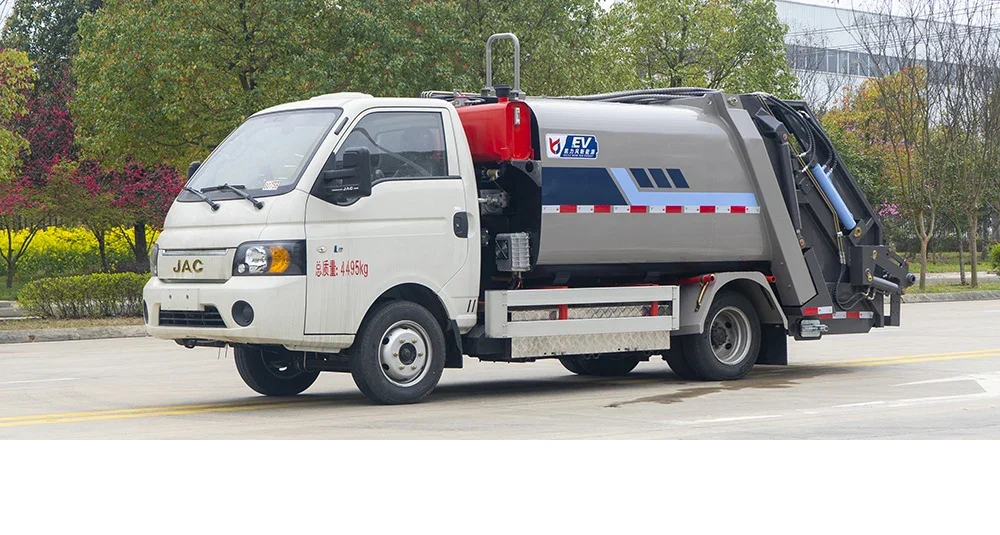
Manufacturer reference photograph. Rear hose fittings, tank closure and underrun equipment sit behind the axle on this compact vacuum truck.
Middle: review tanks, exhaust, batteries, storage and crossmembers between axles.
Rear: review discharge fittings, hose reels, guards, steps and body overhang.
Working configuration: review parts that deploy, lower, raise or move during normal operation.
Ask the supplier to mark each relevant point on the drawing. The lowest chassis axle component may not be the first part to contact a slope. Likewise, a rear fitting can govern departure clearance even when the published ground-clearance field looks adequate. Keep fixed travel geometry separate from deployed working geometry.
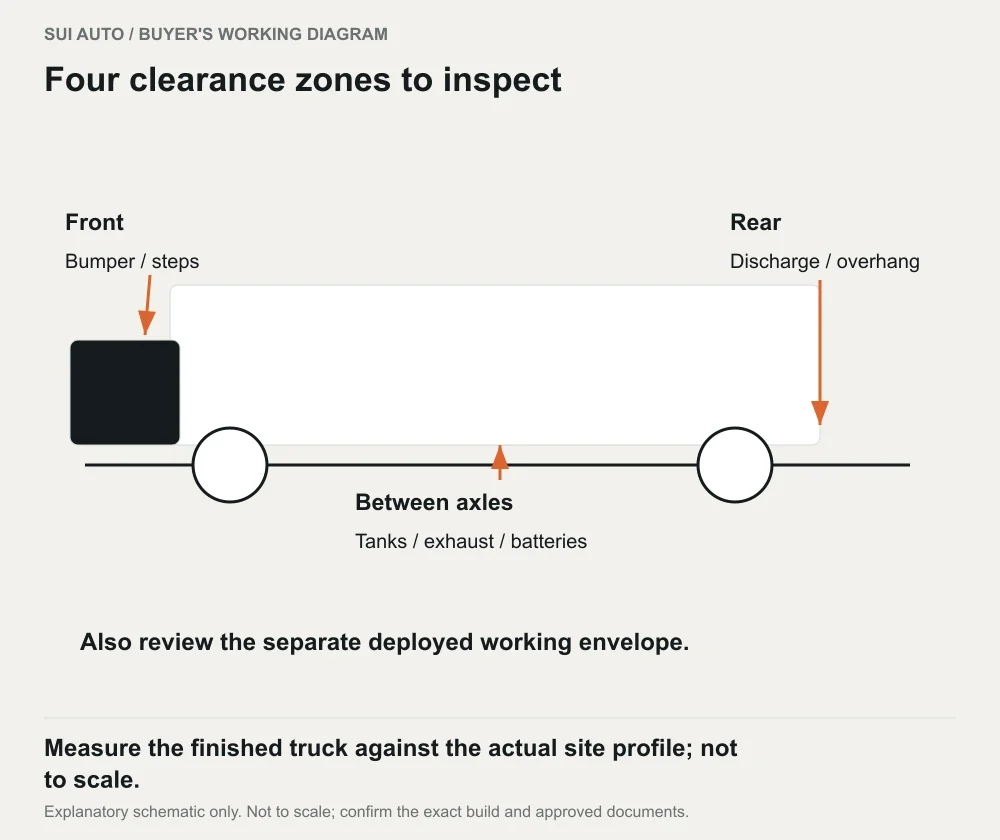
Measure the finished truck against the actual site profile; not to scale. Explanatory schematic.
Measure the site instead of relying on a general rough-road claim
Provide the actual ramp profile, threshold, crest and parking area. Photographs with a scale can help, but a dimensioned survey is more useful where the margin is small. Include the approach direction and any turn required while crossing the obstruction.
Ask how loaded suspension movement affects clearance and whether tyre alternatives change the geometry. Use the specified tyres and loading state in the comparison. A parked empty photograph does not represent every operating condition.
For soft or uneven surfaces, clearance is only one issue. Traction, ground bearing, stability and route suitability need their own assessment. A claim that a chassis is suitable for rough roads should be translated into a defined surface and operating requirement.
A hypothetical disposal-yard ramp
Assume a sewer contractor must cross a short steep ramp before reaching a disposal pad. A proposed larger tank truck has more rear overhang than the existing vehicle. These are illustrative site conditions.
Ask the builder to compare the ramp profile with the finished vehicle geometry in the relevant loaded state. Identify the rear discharge fitting and any protection structure. If a drawing suggests contact, resolve the layout or access plan before production. Removing protective equipment after delivery is not a substitute for a reviewed design.
A controlled site trial can confirm the agreed geometry when conducted by competent personnel. Record the load condition, tyres and approach path. If the site or equipment changes later, keep those records available for a fresh review.
Access changes can affect other requirements
Moving a tank, shortening an overhang or raising equipment can alter axle loads, centre of gravity, service access and the working interface. Ask for the related calculation and drawing revisions. A clearance improvement should be assessed as part of the whole vehicle rather than accepted as an isolated modification.
Tyre changes also require chassis-specific review. A larger-looking tyre is not automatically an acceptable way to gain clearance. Confirm approved size, load capacity, wheel compatibility, brake and steering clearances, and any effect on controls or road-speed calculations.
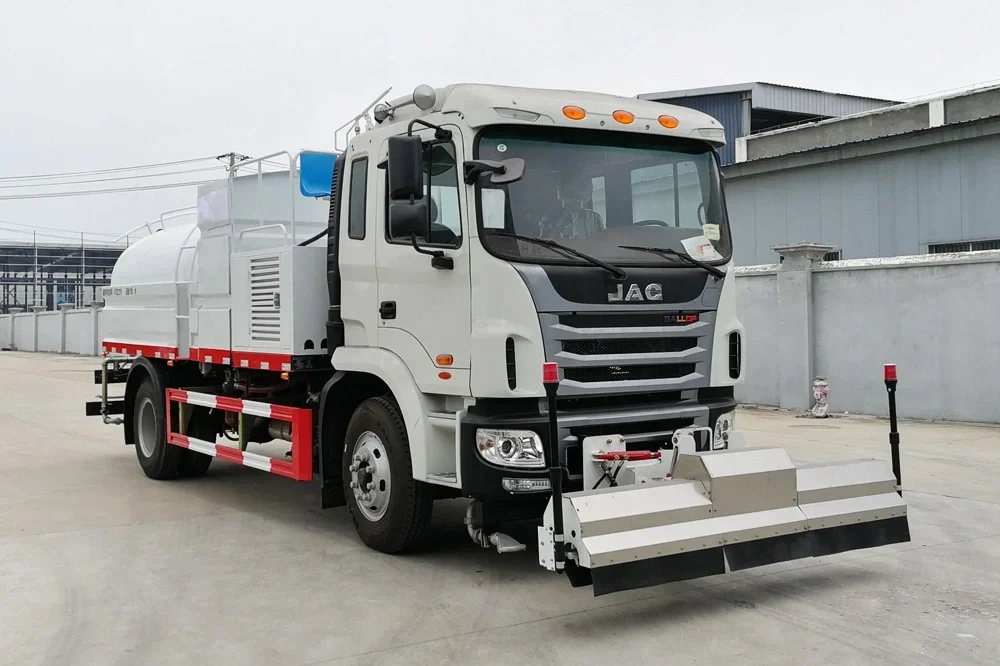
The catalogue's multi-axle sewer and road-cleaning references provide different footprints to discuss. Their photos can reveal questions, but they do not establish a measured clearance at your site. Request exact dimensions from the proposed build.
Enquiry and acceptance checklist
Send site profiles, gate and roof measurements, approach directions, expected loads and any deployed working-space limits. Request finished side and plan views, relevant lowest-point dimensions and travel/working configuration drawings. Ask the supplier to explain the basis of the clearance assessment.
At acceptance, inspect the vehicle with final guards, steps, fittings and tyres installed. Measure the agreed points in the stated load condition. Witness any controlled geometry trial included in the contract and record the actual path. Confirm that manuals identify travel and deployment procedures for movable equipment.
Retain photographs and measurements with the vehicle identity. Accessories added later can become the new lowest point, so update the access review when the installation changes.
Check access after the operator adds equipment
The finished access envelope should include the normal travel positions of hoses, tools and movable accessories. Ask where loose equipment is secured and whether the approved storage arrangement changes the lowest point or rear swing. A truck measured without its working inventory may appear to have more clearance than it has in service. Retain a photograph of the agreed travel configuration. This helps operators and maintenance staff identify whether later storage changes need a new site-access assessment.
Where a site has a sharp change in slope, include the transition profile rather than only the ramp gradient. The same gradient can produce different contact risks with a rounded or abrupt transition. Ask the reviewer to use the measured profile and the completed vehicle geometry together.
Does ground clearance alone tell me whether a truck can cross a ramp?
No. Overhang, wheelbase, ramp profile and loaded suspension condition also affect contact risk.
Can I use a chassis brochure's departure angle for the finished truck?
Body fittings and overhang can change the relevant geometry. Ask for the completed-vehicle measurement.
Will larger tyres solve clearance problems?
Only an approved, reviewed tyre and wheel configuration should be considered. It can affect several systems and may not address the governing contact point.
References and further reading
- Isuzu official body builder guide access
- Daimler Truck official commercial-vehicle body builder information
- Kaili Shacman Delong Combination Sewer Truck manufacturer reference
- CLW Dongfeng 5 m³ Hook Loader manufacturer reference
- Hongyu JAC Gallop Road Cleaning Truck manufacturer reference
- Kaili Shacman Delong Combination Sewer Truck
- CLW Dongfeng 5 m³ Hook Loader
- Hongyu JAC Gallop Road Cleaning Truck
- Overseas buyer guide
Planning a purchase? Follow the overseas buyer guide for specification, payment, shipping and import preparation.