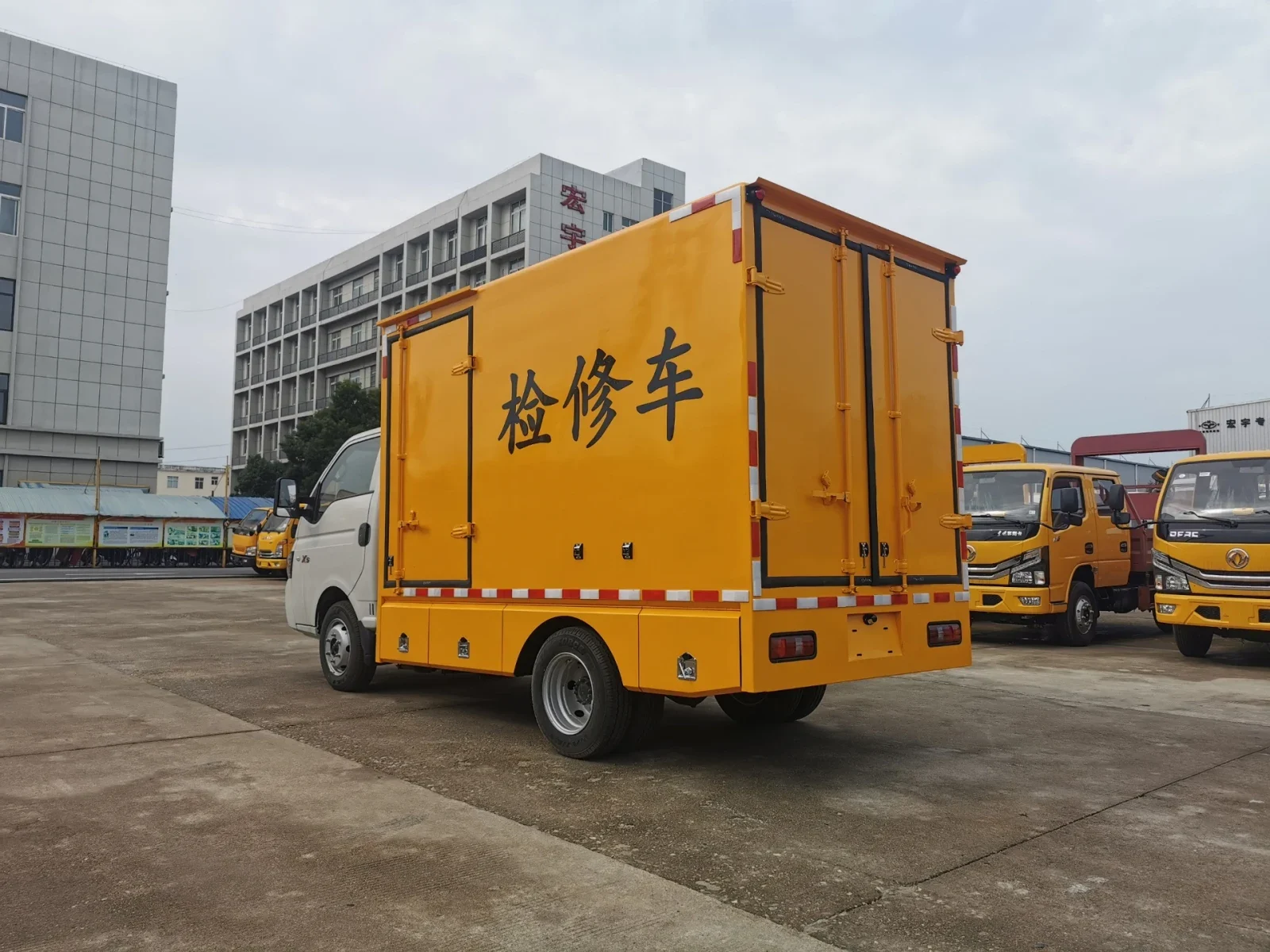
Space is a purchase constraint
If a site cannot accommodate the manufacturer's approved support arrangement, a crane truck is not made suitable by having enough nominal lifting capacity. Treat setup space as a purchase constraint alongside load, radius and road access. The catalog's crane references can be considered only after the supplier provides their exact approved arrangements. Do not assume that outriggers can be partially deployed simply because full deployment is inconvenient. Procurement should expose this uncertainty early, so the site can be reassessed or a different delivery and lifting method can be chosen before equipment is ordered.
A narrow site example
Assume a materials supplier regularly delivers to urban plots bordered by live traffic and neighboring property. This is a planning example, not a verified operating recommendation. The vehicle might fit through the gate while the lifting setup does not fit within the controlled area. The buyer should record boundaries, available standing space, access path and nearby structures with a responsible site representative. Include routes for pedestrians and other vehicles. If the site relies on occupying a road, the necessary permissions and traffic arrangements must be assessed separately; vehicle purchase does not confer access to public space.
Measure the complete footprint
Ask for drawings showing the vehicle and approved support envelope for the quoted crane installation. Review the space needed for personnel, controls, cargo handling and the planned load path, not just the distance between support legs. A competent planner should compare those drawings with reliable site information and the intended lifting task. Distinguish a static footprint from the movement of boom and load. The manufacturer should identify any restricted configurations and related documentation. A buyer should never create a partial support allowance or borrow one from a different crane merely to make a diagram appear workable.
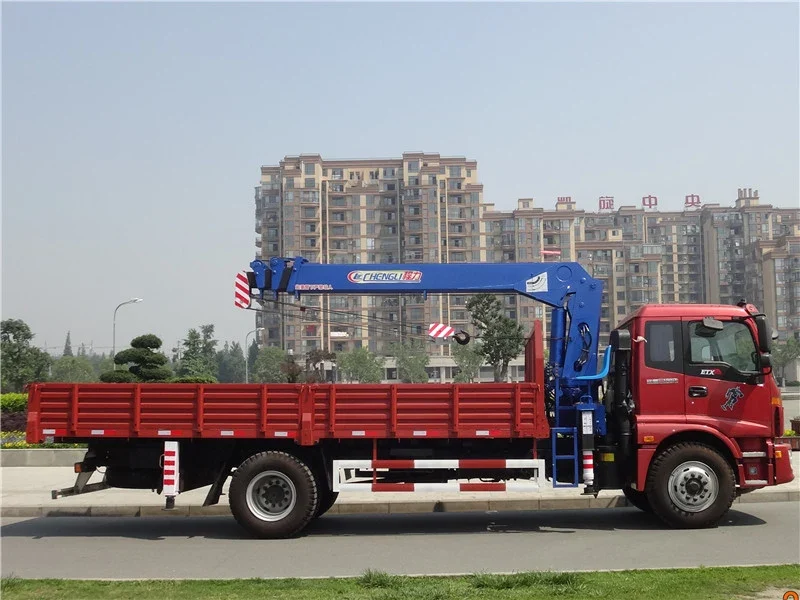
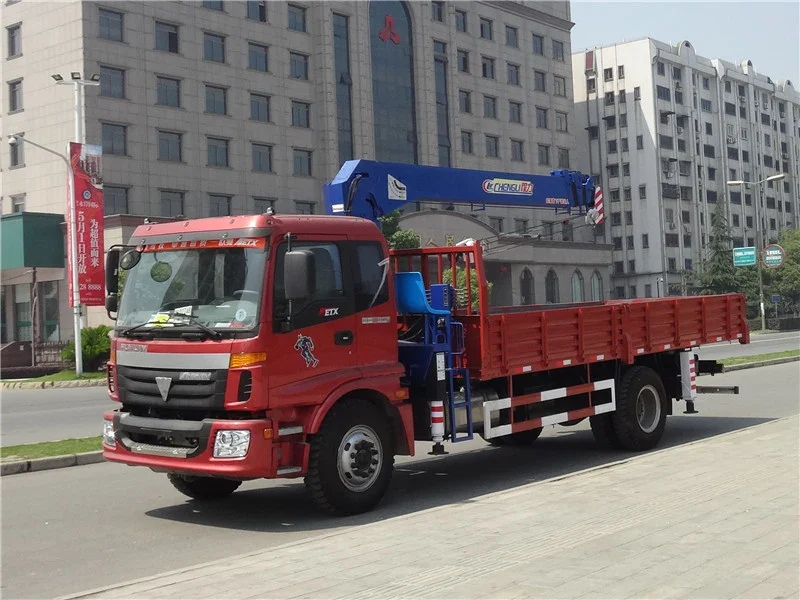
Manufacturer reference photograph. The crane base and folded boom occupy the area behind the cab; road dimensions alone do not describe the required working footprint.
Record vehicle entry, support footprint and load movement as three different drawing checks. Mark each as supported, unsupported or awaiting evidence. A supplier response that proves the truck enters the gate should not automatically mark the other two checks as complete.
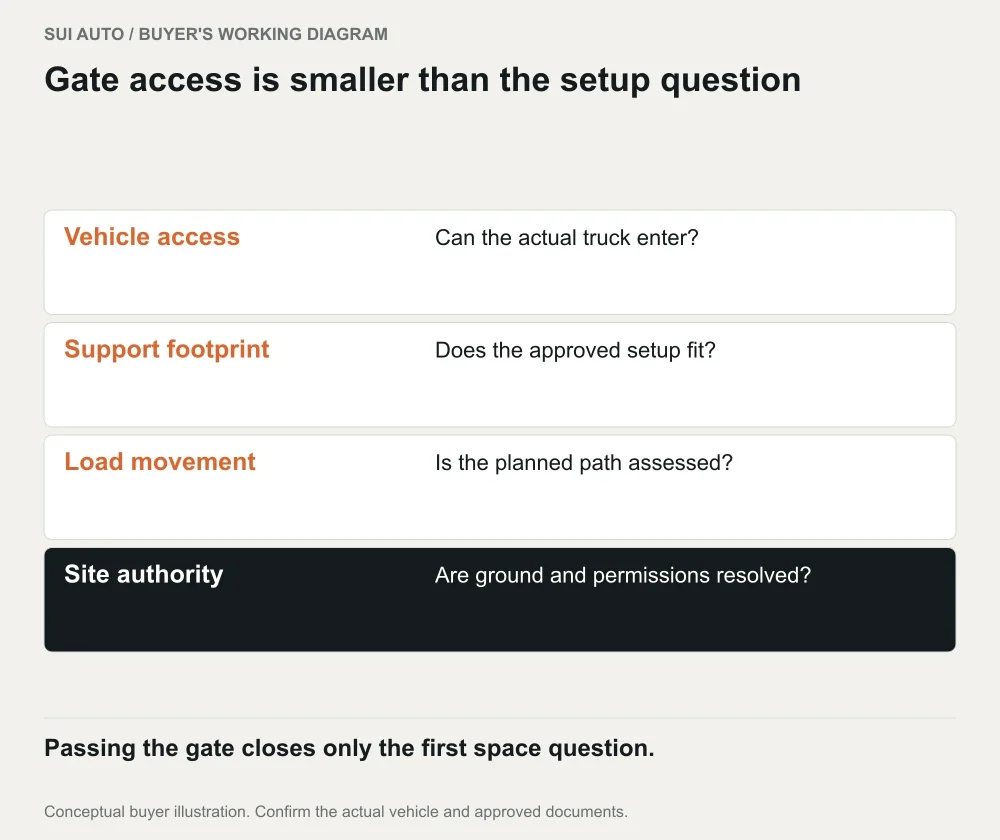
Conceptual illustration. Nested crane-space questions distinguish entry support footprint load path and permissions. Passing the gate closes only the first space question.
The ground below the footprint matters
An apparently wide paved area may still have unsuitable support conditions or concealed features. For United States construction activities within its scope, OSHA 1926.1402 is an official reference concerning crane ground conditions. Elsewhere, local requirements and manufacturer instructions must be assessed. Obtain the site's relevant support information and assign the technical assessment to competent people. Do not infer bearing capacity from a smooth surface or a truck photograph. This guide does not design mats or specify stabilizer loads; it asks the supplier for necessary equipment data and the responsible site specialists for an appropriate assessment.
Consider alternatives without promising equivalence
A different standing position may change required radius and load capability, so it needs a new lifting review. A smaller vehicle may improve access yet have different transport or lifting limits. A separate crane service, delivery to an intermediate location or revised site logistics may be more practical. Each alternative has its own permissions, handling arrangements and cost implications. Compare them explicitly instead of asking an operator to improvise when the truck arrives. Retaining an alternative is especially important for a fleet serving changing sites, where no single truck configuration will necessarily satisfy every restricted environment.
Information to request before quotation
Send the supplier representative site dimensions, boundaries, intended loads, placement positions and access limitations. Request configuration specific charts, support envelope drawings, completed vehicle dimensions and weight evidence. Ask for the manufacturer's approved limitations, operator documentation and support equipment scope. Keep overhead electrical hazards, ground assessment and traffic permissions on separate responsibility lines. A complete enquiry should identify who closes each issue and which sites remain unverified. If the supplier cannot document a proposed setup, leave that work outside the agreed capability instead of using a reassuring verbal statement as acceptance evidence.
Inspection should confirm the promised arrangement
Check that the delivered crane, support system and control equipment match the reviewed configuration. Obtain final drawings and charts rather than accepting provisional marketing diagrams. Any demonstration should occur under an authorized plan, with suitable space and qualified personnel. Record what was demonstrated and what remained outside the test. Train the receiving team to consult documentation and seek a site review when conditions differ. Preserve the support information in the vehicle file. A practical handover also identifies where unresolved site questions go, so a dispatch planner does not turn uncertainty into an informal permission to operate.
Questions about constrained setups
Can outriggers stay inside the vehicle width? Only a manufacturer approved configuration and task assessment can answer; do not assume this from a photograph. Does road pavement guarantee adequate support? No; the actual supporting conditions need assessment. Is a smaller crane always safer in a narrow area? Suitability depends on the task and approved setup, including load, radius, support and hazards. If these are unresolved, a smaller capacity label is not a substitute for planning. Choose documented capability over a vehicle that merely looks easier to park.
References and related reading
Planning a purchase? Follow the overseas buyer guide for specification, payment, shipping and import preparation.