Start from the delivered component list
A useful first-year spare-parts kit belongs to a specific truck configuration. Ask for the chassis and equipment model references, part numbers and applicable service information before choosing quantities. A generic kit described as suitable for all water trucks or all compactors may contain the wrong seals, filters or connectors. The supplier should distinguish routine service items from specialist replacement components and tools. Treat the first year as a planning horizon, not a promise that parts will last for exactly that period. The vehicle's duty, environment and maintenance requirements determine the items worth reviewing.
Separate chassis items from body equipment
Your local workshop may already obtain chassis filters and other normal service parts, while a specialist pump or body-control item may need a different source. Create separate lists and verify local availability using exact identities. For each mounted component, request the maker, model, serial-reference method and approved parts catalogue. Where a seal or hose specification matters, ask the manufacturer to identify the approved replacement rather than selecting by visual resemblance. Do not include dangerous field repairs in the plan merely because a spare is available. Some replacements need trained personnel, controlled conditions or manufacturer support.
Use consequence and lead time to prioritize
Classify each item by how often it is serviced, the effect of its unavailability, local sourcing options, storage needs and cost. A low-cost connector that prevents the truck working with your depot equipment may deserve attention; an expensive assembly available locally may not need duplicate stock. Obtain indicative lead times without presenting them as guarantees. Check shelf-life or storage instructions for seals, fluids and other sensitive materials. The kit should reduce credible downtime exposure rather than maximize the number of boxes shipped. Record why an item is included so the list can be reviewed after real operating experience.
A useful selection row names the exact part, the function lost without it, the verified replenishment route and the storage condition. Compare a required operating connector unavailable locally with a routine filter the workshop can obtain by confirmed part number. The first can deserve a different stock decision despite its lower price. Leave quantity open until utilization and the approved maintenance schedule are available.
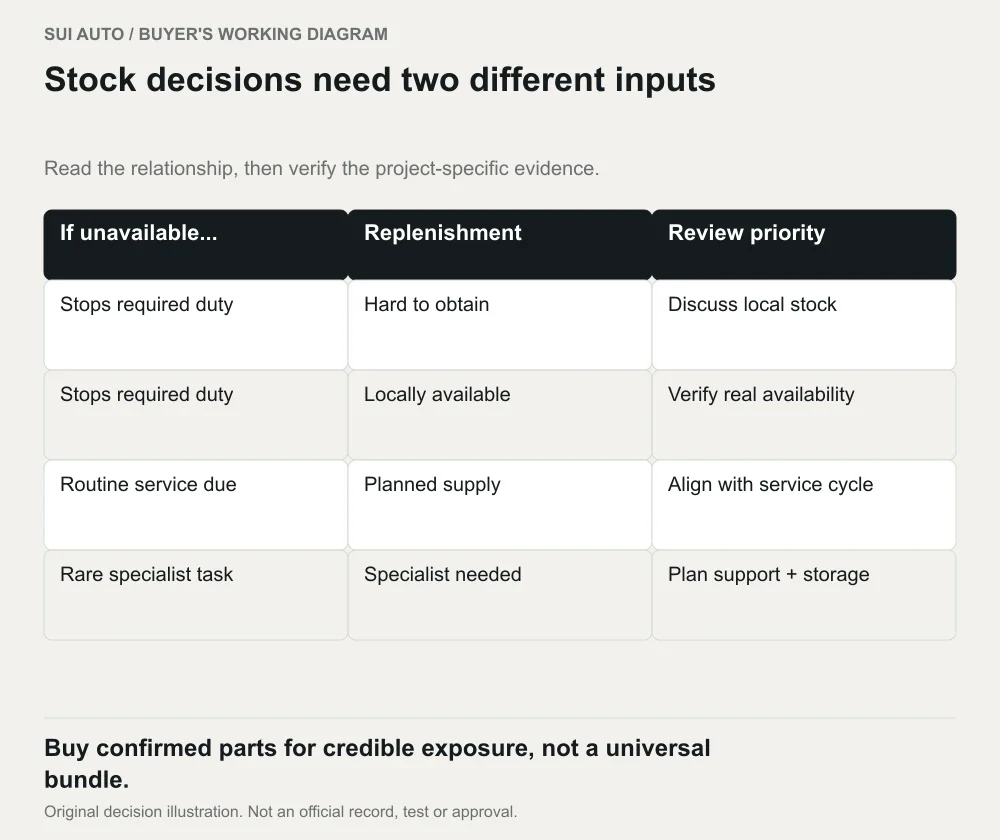
Buyer illustration: qualitative stocking prompts; quantities require the actual maintenance and fleet plan.
A hypothetical vacuum-truck kit discussion
A buyer operating a vacuum truck in a remote district asks the supplier and workshop to review approved hose connections, service filters, seals and the equipment's maintenance documentation. The review identifies which consumables are locally available and which model-specific items need ordering with the vehicle. It also identifies tasks that the local workshop cannot safely perform. No quantities are set until the workload and service schedule are agreed. This example illustrates the selection process, not a universal parts list or a guarantee of reliability. The exact kit for your truck must match its supplied pump and body equipment.
Make the inventory identifiable on arrival
Ask for a packing list linking package number, item description, part number, quantity and the vehicle or component it serves. Request clear labels and an electronic inventory that your storekeeper can maintain. Keep any item-specific handling or storage information with the package. Separate loose accessories supplied for normal operation from optional spares so missing operating equipment is not dismissed as a spare-parts issue. Check the list against the physical packages during pre-shipment inspection and on receipt. A box marked accessories is not enough evidence to establish that all the agreed parts were delivered.
Coordinate spares with the import file
Tell the forwarder and broker which items travel separately, how they are described and whether any item needs special handling or documentation. Spare parts may not share the complete truck's classification or documentation treatment. Use truthful itemized descriptions rather than hiding parts inside a broad vehicle line. The International Trade Administration's packing-list guidance emphasizes identifying package contents; destination requirements still need a broker's review. Update the kit after the first maintenance cycle using actual consumption and availability. This allows future group purchases to reflect fleet experience rather than simply repeating the original supplier bundle.
Can I substitute parts bought from another supplier?
Ask the equipment or chassis manufacturer to confirm the replacement identity and applicability. Matching shape or thread size does not establish material, pressure, electrical or performance suitability. Keep any approved substitution with the vehicle's service records and use qualified installation where required.
How many parts should I order?
There is no reliable universal quantity. Use the approved maintenance schedule, planned utilization, number of similar units and replenishment route. A shared fleet kit may be sensible when components genuinely match, but identical vehicle category names do not prove that their service parts are interchangeable.
References and related reading
Planning a purchase? Follow the overseas buyer guide for specification, payment, shipping and import preparation.