Describe the people and equipment together
Specify the intended occupants, tools and materials as one platform-load requirement, then ask the manufacturer to confirm the supported working envelope. Working height alone cannot establish whether an aerial platform truck suits the task. A platform-capacity figure also needs its associated person limit and configuration conditions.
This review focuses on usable platform load during the intended work. It differs from a general height-and-outreach comparison or a site-readiness checklist. The buyer needs to know what the selected machine supports when the real maintenance crew and its equipment are included, rather than comparing an empty basket at maximum reach.
Create a task inventory instead of a single allowance
List the number of people expected on the platform and the equipment used for each task. Include tools, replacement components and materials brought to height. Ask the employer or responsible task planner to provide the intended load information. Keep estimated and confirmed values visibly separate.
IPAF explains that platform safe working load includes the permitted people and other load. Use that as a reason to define the complete task inventory. Do not invent a standard worker mass or assume that every platform's capacity convention is identical. The actual manufacturer's documentation and the employer's task assessment should establish the applicable requirement.
Connect load to the working envelope
Request the actual platform model's approved working-envelope information and configuration limits. Ask how the required load is supported at the intended height and outreach, including any relevant restrictions. A single maximum height and a separate maximum radius should not be interpreted as one simultaneous operating point.
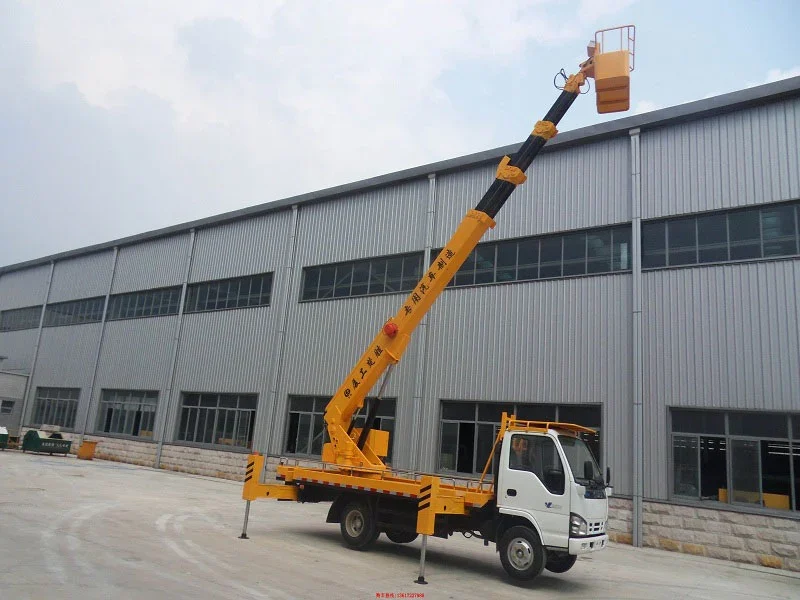
Hongyu's 23-meter reference publishes the working radius at maximum height and the height at maximum radius separately. That illustrates why buyers need the envelope rather than a pair of maxima. It does not establish a site-specific operating position or guarantee that another machine with the same height designation has the same capabilities.
Check how the equipment fits inside the platform
Ask for usable platform dimensions and the approved method of carrying the proposed equipment. Review access through the platform entrance and the working space remaining for the occupants. A tool or replacement component can fit within the mass allowance while still being unsuitable for the platform arrangement.
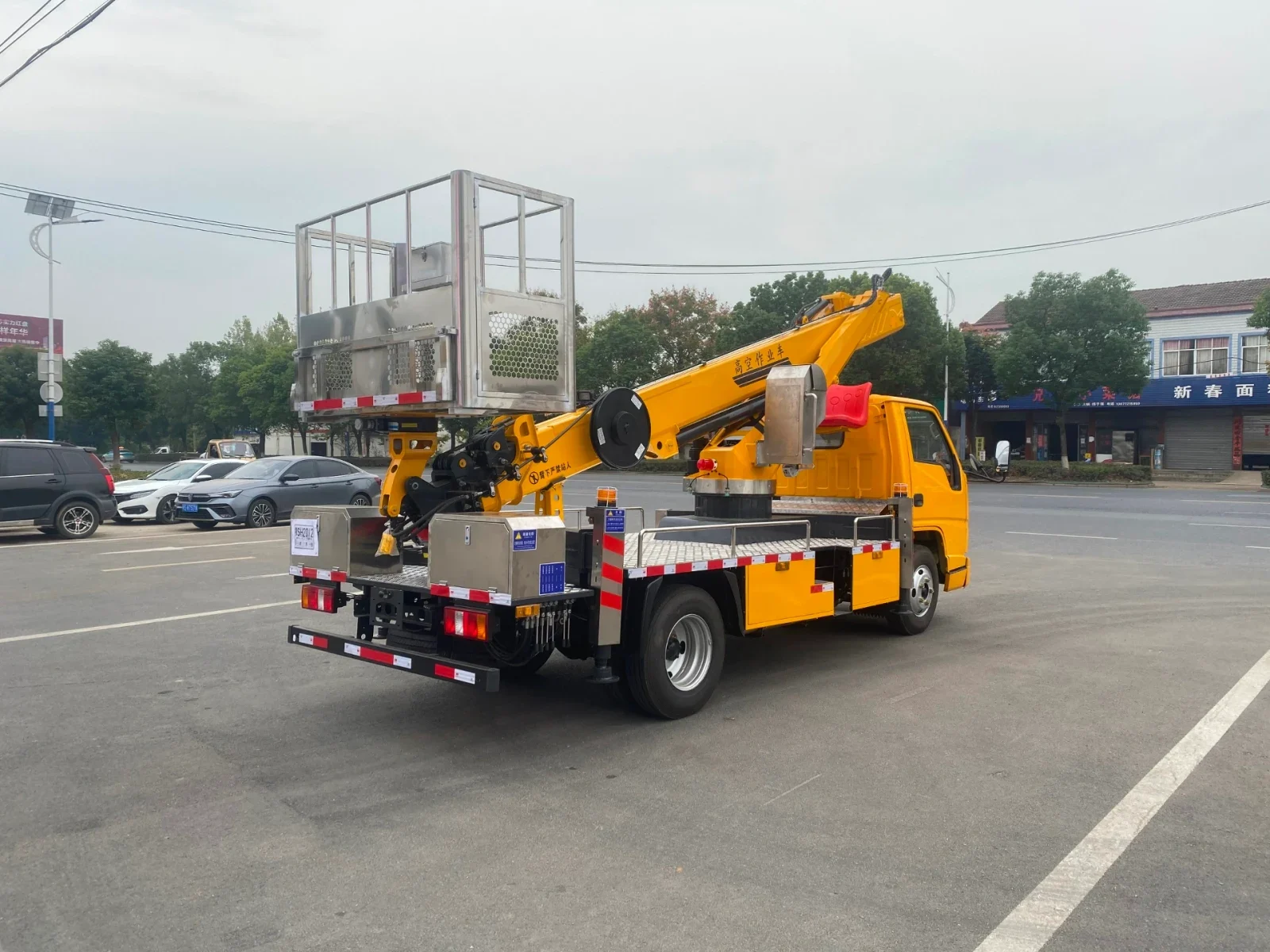
Manufacturer reference photograph. The basket and folded boom show the available work-platform arrangement; confirm the actual people-and-tools inventory with the supplier.
Have the manufacturer assess any proposed racks, holders or other attachments. Their own mass and interface belong in the review. Do not assume that a locally fabricated extension or a component suspended outside the platform is allowed. The tender should identify any such requirement early so the supplier can provide an approved solution or explain the limitation.
Keep the person limit visible
The platform may have both a load limit and a maximum number of occupants. Meeting one does not independently satisfy the other. Ask how the permitted occupancy and load are identified on the supplied machine and in its documentation. Include the intended crew composition in the supplier's written application response.
If different work packages use different crews or equipment, assess each package separately. Do not average their masses across a shift. A purchasing schedule can show the proposed cases and the manufacturer's conclusion for each. This makes restrictions understandable before ordering, instead of leaving the operator to infer them from a sales brochure.
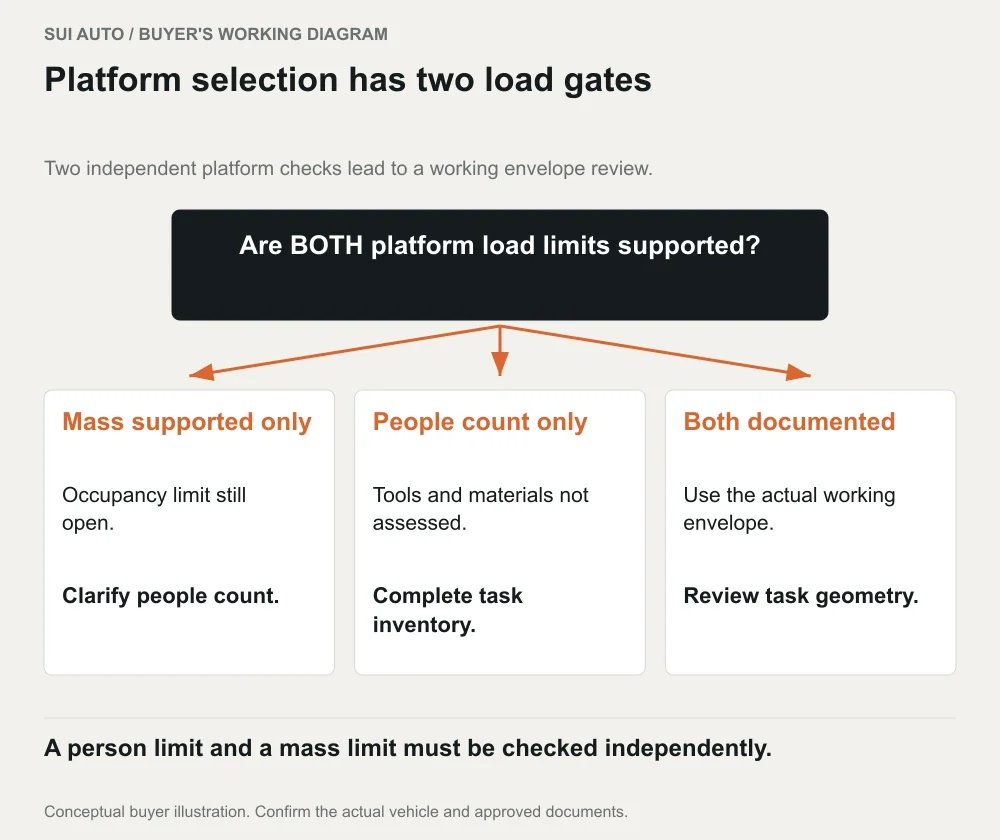
Conceptual illustration. Two independent platform checks lead to a working envelope review. A person limit and a mass limit must be checked independently.
A hypothetical street-light maintenance contract
Assume a contractor wants a platform for a two-person task with tools and replacement fittings. Its initial tender specifies only the height of the street lights. The revised brief gives the complete task inventory, intended outreach and access conditions, and asks for the manufacturer's supported working envelope.
The response may identify a suitable platform, limit the planned equipment arrangement or require another model. These are possible outcomes rather than a lift calculation. The example does not prescribe a safe working position or establish the suitability of either linked reference vehicle. Actual setup, ground conditions and rescue planning still need the responsible parties' assessment.
Define acceptance around the approved configuration
Require the exact platform and chassis identities, working-envelope documents, capacity and occupancy markings, and the approved equipment arrangement. Ask the supplier to propose an appropriate functional demonstration under its procedures. Training and inspection records should identify the delivered configuration.
A photograph of the platform raised without its intended task load can illustrate motion but cannot establish the full contracted duty. Record what the factory demonstration actually covers and which checks remain for local commissioning. If an attachment or platform variant changes before delivery, obtain the manufacturer's review before accepting the original application response as valid.
RFQ checklist for platform-load decisions
Provide the task, people count, equipment inventory, required positions and relevant site information. Request usable platform dimensions, the associated load and occupancy limits, approved working-envelope information and any attachment approval. Ask who confirms compatibility with the actual chassis installation.
At handover, match the supplied documents and markings to the ordered platform. Keep restrictions accessible to the person planning each task. Changes to tools, carried materials or crew requirements should return to that review rather than being assumed acceptable because the truck previously reached the same street light.
FAQ: Is platform capacity a cargo-only allowance?
Check the manufacturer's convention. The stated safe working load concerns the permitted occupants and other platform load, with the person limit considered alongside it.
FAQ: Can maximum height and maximum outreach occur together?
Do not assume so. Request the actual working envelope and the conditions applying to the required position and load.
FAQ: Can a tool rack be added after purchase?
Obtain the manufacturer's approval for its mass, attachment and effect on the platform arrangement. Treat it as a configuration change rather than an unreviewed accessory.
References and further reading
Planning a purchase? Follow the overseas buyer guide for specification, payment, shipping and import preparation.