Attach a buildable specification to the purchase order
A useful truck purchase order identifies the accepted technical annex, drawing revisions, equipment list and acceptance records. Agree how conflicts between those documents will be resolved before the order is approved. A model name and a marketing quotation leave too much interpretation to the production team. Give every controlled attachment an identifier and revision. List the attachments on the order itself, with their dates and approval status. Ask the supplying manufacturer to confirm that the same package will be issued to purchasing, fabrication, installation and testing.
Distinguish requirements from reference information
A reference product page helps the buyer choose a starting point. The order annex defines the particular build. Separate confirmed requirements from illustrations, optional equipment and open questions. For each specification line, record the requirement, evidence expected and responsible approver. Where the source lists several chassis options, select one explicitly or retain the choice as an unresolved issue. Do not copy all variants into a single configuration. Photographs should identify the feature they illustrate; a picture of another truck should never silently override a written equipment list.
Agree a document priority rule
A document hierarchy is a negotiated project control. Ask the parties to state which approved document governs if the order, drawing and equipment schedule disagree. Include a procedure for raising the conflict and recording the resolution. The procurement team should avoid inventing a universal legal order of precedence. Have the responsible commercial advisers review contractual wording where necessary. The operational goal is clear: the factory should stop at a visible inconsistency and obtain a recorded decision, rather than choosing whichever attachment reached the workshop most recently.
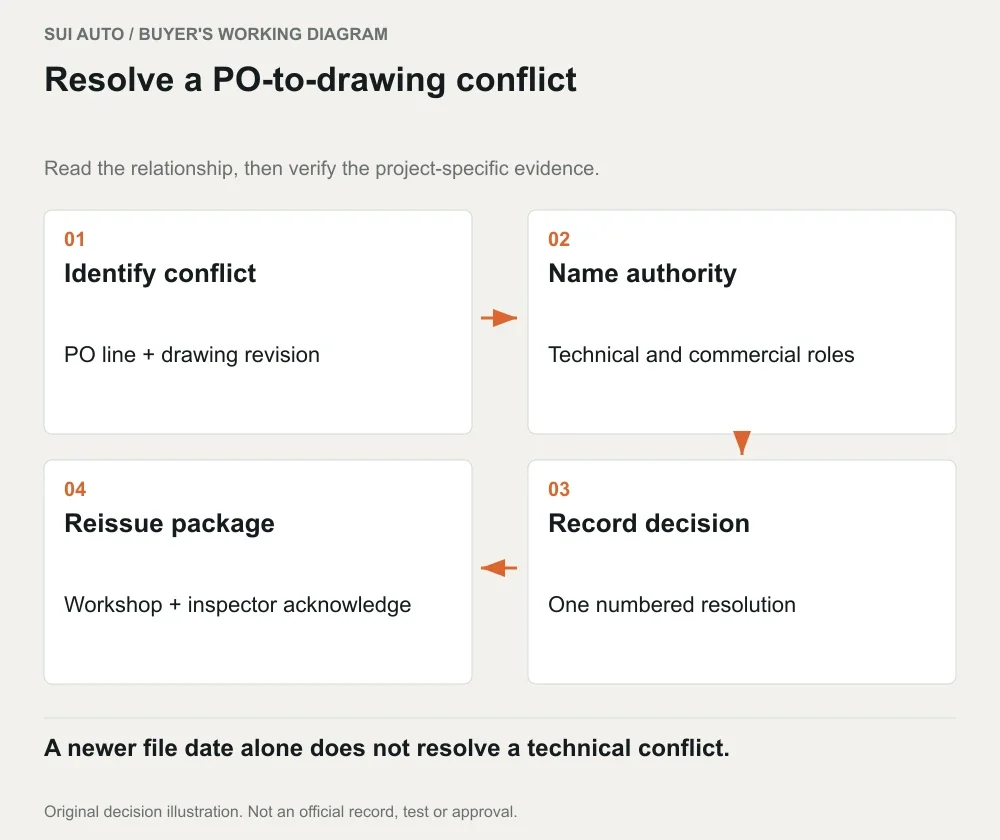
Buyer illustration: order-attachment reconciliation workflow with no assumed legal priority.
Write measurable acceptance lines
Replace an open phrase such as suitable pump with the confirmed pump identity, required duty and agreed test record. For a rescue vehicle, list crane model, applicable load-chart reference, storage drawings and tools supplied. State the inspection method for each critical requirement and distinguish visual checks from measured or witnessed tests. SGS describes inspection against technical specifications and contractual requirements; your annex gives the inspector those requirements. Avoid borrowing numerical tolerances from unrelated vehicles. Obtain the actual acceptance limits from the responsible technical parties and the agreed project specification.
A hypothetical annex conflict
Consider illustrative Order PO-104, Annex R2 and compartment drawing D-18 R1. The annex specifies one tool set while the drawing includes storage for an older set. Before fabrication, the buyer marks the discrepancy as unresolved and requests a corrected drawing. The revised drawing is approved as D-18 R2 and the attachment register is updated. The example demonstrates the control process; it is not a project record or legal template. The important evidence is the closed decision and its distribution to the people building the vehicle.
Check the package before release to production
Use this release checklist: correct legal parties; selected model and chassis; approved annex revision; drawing register; equipment and loose-item schedule; inspection plan; agreed exceptions; required manuals and records; and approval authority. Assign each open item an owner and required decision date. Ask the manufacturer to acknowledge the package as a whole. If an item remains provisional, explain which work can proceed without it and which activity must wait. This prevents a small unanswered accessory question from being confused with full technical approval.
Give production a current-document register
Ask how superseded documents are withdrawn from purchasing and workshop use. Record the issue date, recipients and acknowledgment of each approved package. At final review, compare the as-built configuration with that register and identify any accepted deviations. A current drawing on the buyer’s computer does not establish that the installation team received it. The distribution record provides a practical check that the approved instruction reached the people responsible for the work.
Should every email become part of the order?
Archive relevant communication, but move accepted technical decisions into the controlled annex or decision register. Workshop staff need a reliable current instruction. An inbox containing contradictory messages makes that difficult. When an email approves a requirement, identify the affected document and revision, then update the register. Agree how electronic approvals are recorded and who may give them. The file should allow a new project engineer to find the current requirement without reconstructing months of conversation.
Can the manufacturer use an equivalent component?
Set an approval process for proposed substitutions. Ask for the replacement identity, technical comparison, interface implications, documentation and effect on maintenance support. The buyer's authorized technical contact should record the decision before installation. A broad phrase allowing equivalent parts can leave important questions unanswered. The control should fit the criticality of the component and the agreed procurement terms. Keep the accepted substitution visible in the as-built equipment schedule and spare-parts references.
What if the signed order and approved drawing contradict each other?
Raise a numbered discrepancy that identifies both documents, their revisions and the affected requirement. Apply the conflict-resolution process agreed for the project and obtain a recorded decision from the authorized parties. Update the controlling attachment and its distribution register before the affected work proceeds. If no priority rule was agreed, seek the appropriate commercial and technical review instead of assuming that the newest date automatically wins. The factory should acknowledge the resolved package, and the acceptance reviewer should be able to find the same decision in the final file.
References and further reading
Planning a purchase? Follow the overseas buyer guide for specification, payment, shipping and import preparation.